What a Labor Union Actually Is
A labor union is an organized association of workers formed to advance their collective interests in the workplace. Rather than each employee negotiating alone, union members act together — giving workers more leverage when dealing with employers over pay, benefits, hours, and safety conditions.
Unions exist across a wide range of industries, from construction and manufacturing to teaching, healthcare, and entertainment. The legal foundation for private-sector union activity in the U.S. is the National Labor Relations Act of 1935, which established workers' rights to organize and created the National Labor Relations Board (NLRB) to oversee elections and resolve disputes.
Collective bargaining
The formal process in which a union and an employer negotiate a written contract covering wages, benefits, and working conditions. Both sides are legally required to bargain in good faith.
Collective bargaining agreement (CBA)
The written contract that results from collective bargaining. It sets the rules of employment — pay scales, hours, grievance procedures — for the life of the contract, typically two to four years.
Right-to-work law
A state law that prohibits making union membership or the payment of union dues a condition of employment. More than half of U.S. states have enacted some form of right-to-work legislation.
NLRB (National Labor Relations Board)
The federal agency that administers the National Labor Relations Act. It oversees union elections, investigates unfair labor practice claims, and enforces workers' rights to organize.
Union density
The percentage of workers in a given industry, region, or country who are members of a union. It is the standard measure used to track union strength over time.
Grievance procedure
A formal process spelled out in a union contract that allows workers to file complaints if they believe the employer has violated the agreement. The union typically represents the worker through each step.
How Unions Work: Organizing, Bargaining, and Contracts
The union process typically begins with an organizing campaign. When a sufficient share of workers at a workplace sign authorization cards — generally at least 30% to trigger a formal election — the NLRB can conduct a secret-ballot election. If a majority votes yes, the union is certified as the workers' exclusive bargaining representative.
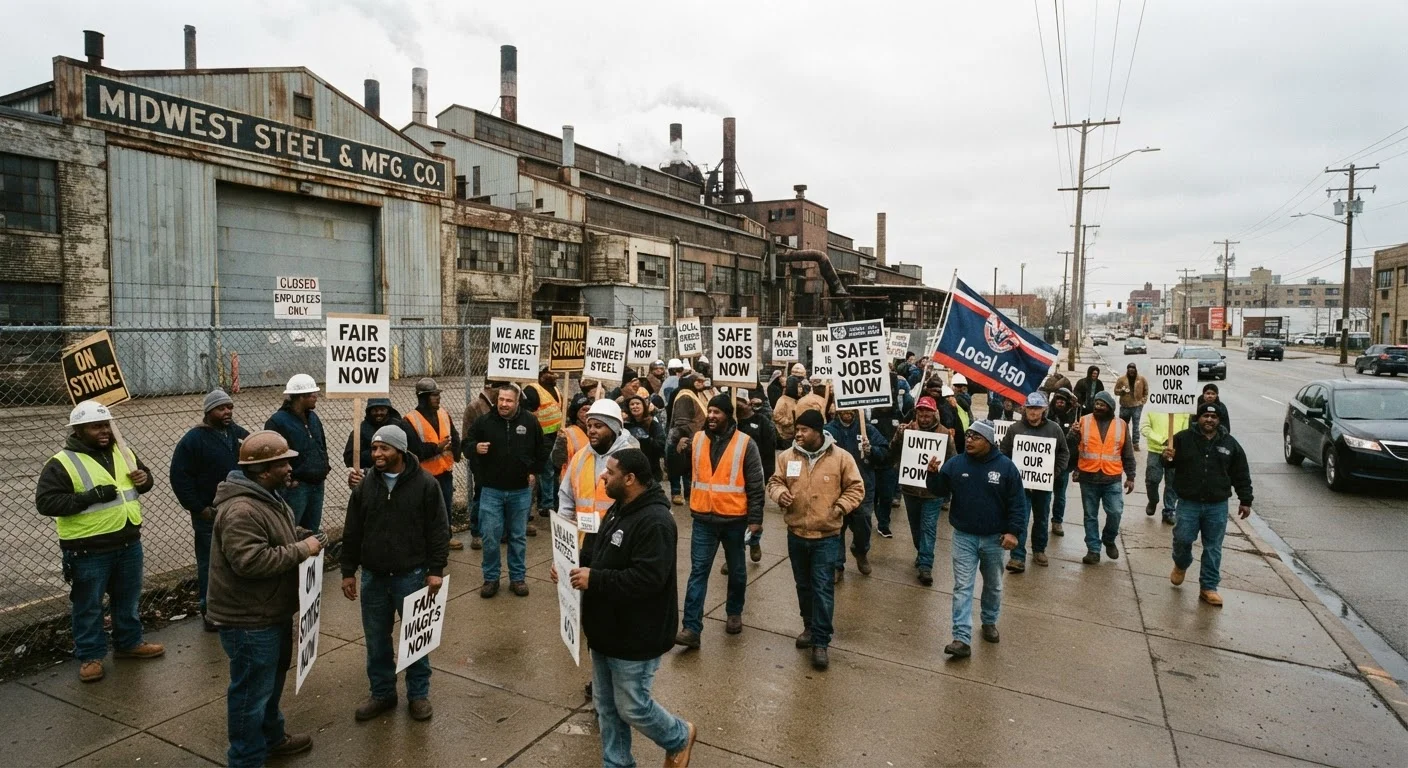
From there, the union and employer enter collective bargaining: structured negotiations to produce a written contract (called a collective bargaining agreement, or CBA) that governs employment terms for the duration of the contract, often two to four years. If negotiations break down, workers may legally strike — withholding their labor — though strikes are relatively rare and carry real financial risk for workers.
Once a contract is in place, the union monitors compliance and represents workers in grievance proceedings if they believe the employer has violated the agreement. This day-to-day representation is a core part of what dues payments fund.
The Decline of Union Membership — and Recent Shifts
Union membership in the U.S. peaked at roughly 35% of wage and salary workers in the mid-1950s. By 2023, the Bureau of Labor Statistics reported that figure had fallen to approximately 10%. The decline accelerated after the 1980s and reflects a combination of forces: the shift away from heavily unionized manufacturing toward service-sector jobs, globalization, legislative changes, and active employer opposition to organizing.
Public-sector unions held up better than private-sector ones. Government workers — teachers, firefighters, postal employees — are unionized at far higher rates than workers in retail or food service.
However, recent years have brought visible new organizing campaigns. Workers at several large retail chains, coffee shop chains, university campuses, and technology companies launched union drives that drew national attention. Whether these campaigns signal a durable reversal of long-term trends or remain isolated exceptions is a question labor economists continue to study. The broader context of worker bargaining power connects to discussions of social mobility and economic opportunity in the United States.
Check Your State's Labor Laws
Union rights and dues requirements vary significantly depending on where you work. If you are considering joining or forming a union, the National Labor Relations Board website (nlrb.gov) provides plain-language guides to worker rights by state and sector. State labor department websites are also a reliable starting point for understanding local rules.
What Research Shows About Unions and Worker Outcomes
Bureau of Labor Statistics data consistently show that union members earn higher median weekly wages than nonunion workers in comparable roles. Unionized workers are also more likely to have employer-provided health insurance and defined-benefit pension plans. These differences are well-documented, though economists debate how much is caused directly by union membership versus other factors, such as the industries and occupations where unions remain strongest.
Research also suggests a broader effect sometimes called the union wage premium spillover: wages in industries with significant union presence tend to be higher even for non-union workers, as employers compete for labor or preemptively offer better terms to discourage organizing. This dynamic is harder to measure precisely and its magnitude varies by sector.
Unions and the gig economy represent different ends of the worker-protection spectrum. For a look at the trade-offs facing workers without traditional employment protections, see the trade-offs of gig work.
Unions in the Broader Economy
The role of unions extends beyond individual workplaces. Labor economists have linked higher union density to reduced income inequality at the national level, though establishing direct causation is methodologically difficult. The post-World War II decades — when union membership was at its height — also saw broad wage growth across income levels, a pattern that has since reversed. Whether strengthening unions would restore that pattern, or whether other structural changes dominate, remains contested among researchers.
Unions also intersect with policy debates about minimum wage laws, workplace safety regulation, and automation. As technology reshapes labor markets, some argue unions provide a mechanism for workers to negotiate the terms of those transitions. For context on how automation is currently affecting employment, see what labor economists currently understand about AI and jobs.
Understanding unions is one piece of a larger picture of how the American labor market operates. Key economic indicators — from unemployment figures to wage growth data — help place union trends in broader context.
This article is for general informational purposes only and does not constitute legal, financial, or labor-relations advice. Specific rights and rules vary by state, industry, and workplace. Readers with questions about their own employment situation should consult a qualified labor attorney or contact the National Labor Relations Board.