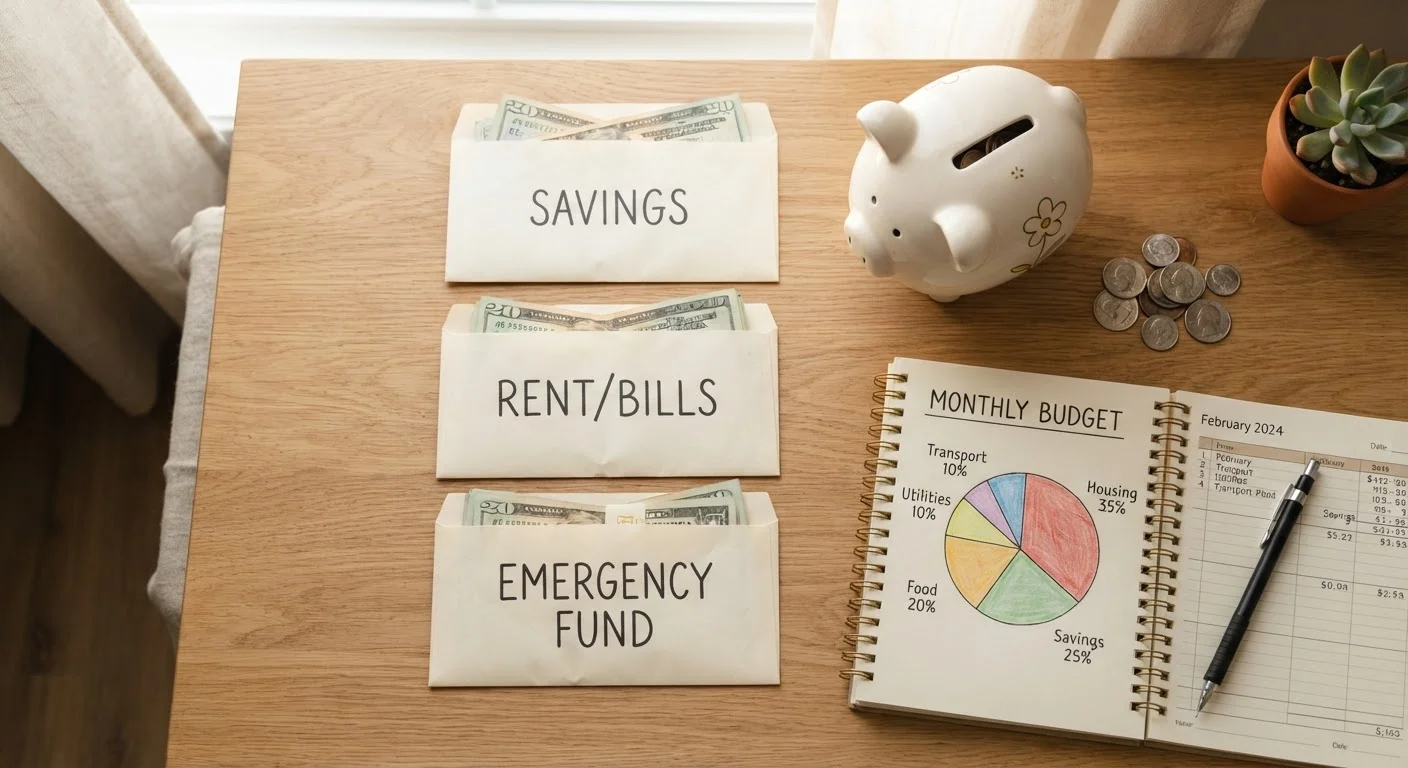

Why Budgeting Matters
A budget is not a restriction on your life — it is a map of your financial choices. Without one, spending decisions happen reactively, savings are whatever is left over (often nothing), and financial goals remain abstract. With one, every dollar has a purpose before the month begins.
Research consistently shows that people who track their spending are more likely to save consistently, carry less high-interest debt, and report lower financial stress. Budgeting is the foundational habit that makes all other financial progress possible, from eliminating debt to building wealth. To explore what comes after a solid budget is in place, see the Saving & Investing hub for foundational concepts on growing your money.
Establishing Your Income Baseline
Every budget begins with a single, honest number: your net income — the amount that actually lands in your bank account after federal and state taxes, Social Security contributions, and any employer deductions such as health insurance or a retirement plan contribution.
If your income is salaried, this is straightforward. If you are self-employed, a freelancer, or earn commission, use a conservative monthly average based on your three to six lowest-earning months of the past year. Building a budget on peak income leads to chronic shortfalls.
When calculating your income baseline as a variable earner, anchor to your worst recent quarter — not your average. A budget built on optimistic income projections will fail in slow months.
Variable income is inherently unpredictable; conservative baseline planning prevents budget shortfalls that lead to debt accumulation.
Run a subscription audit every six months. Cancel anything you have not actively used in the past 30 days and redirect those dollars to savings or debt repayment.
Subscription services are designed for low-friction sign-up and high-friction cancellation. Regular audits counteract that dynamic and reclaim meaningful budget capacity.
Include all income streams — a side job, rental income, or regular cash gifts — but only count sources that are reliable and recurring. One-time windfalls should be allocated intentionally when they arrive, not baked into a baseline.
Tracking and Categorizing Expenses
Before setting any limits, spend at least one full month documenting every expense. Most people underestimate their spending by 20–30% when relying on memory alone. Bank and credit card statements are the most reliable source.
Organize expenses into three categories:
- Fixed expenses: Rent or mortgage, car payment, insurance premiums — amounts that do not change month to month.
- Variable necessities: Groceries, utilities, gas — costs that fluctuate but are non-negotiable.
- Discretionary spending: Dining out, subscriptions, entertainment — where the most budgeting flexibility exists.
This exercise often reveals spending patterns that surprise even financially aware people. Subscription creep — accumulating small monthly charges that add up to a significant sum — is one of the most common culprits. Pair smarter budgeting habits with the Savvy Buying Habits hub for guidance on making more intentional everyday purchasing decisions.
Choosing a Budgeting Framework
No single method works for everyone. The right framework is the one you will actually maintain. Three widely used approaches:
The 50/30/20 Rule
Allocate 50% of net income to needs, 30% to wants, and 20% to savings and debt repayment. This is a useful starting point, though the percentages may need adjustment based on cost of living — in high-rent cities, needs often consume more than 50%.
Zero-Based Budgeting
Every dollar of income is assigned a job until income minus expenses equals zero. This method demands more attention but leaves no money unaccounted for. It is especially effective for people who find money disappearing without explanation.
Pay Yourself First
Savings contributions are automated immediately when income arrives, and spending is managed from what remains. This method removes the temptation to spend before saving.
Avoid Building a Budget on Gross Income
A common mistake is planning monthly spending based on your gross (pre-tax) salary. Taxes, retirement deductions, and insurance premiums can reduce take-home pay by 20–35%. Always use net income as the foundation. Budgeting from gross almost always results in consistent overspending.
Managing Debt Within Your Budget
Debt repayment must appear as a fixed line item in any realistic budget — not as an afterthought. Two widely recognized repayment strategies:
- Avalanche method: Direct extra payments toward the highest-interest debt first. This minimizes total interest paid over time and is mathematically optimal.
- Snowball method: Pay off the smallest balance first regardless of interest rate. Each eliminated account creates psychological momentum.
Neither method works without consistent minimum payments on all accounts. Missing minimums triggers penalty fees and credit score damage that compounds the problem.
This article provides general financial information and is not personalized financial, tax, or legal advice. Consult a qualified financial professional for guidance specific to your situation.
Building an Emergency Fund
An emergency fund is a savings buffer held in a liquid, accessible account — typically a savings account — reserved exclusively for genuine financial emergencies: job loss, a medical bill, or an urgent car repair. Financial guidance broadly recommends accumulating three to six months of essential living expenses.
If starting from zero, a more achievable first target is $1,000. That amount covers the majority of common unexpected expenses and prevents small crises from becoming credit card debt.
Automate a fixed transfer to your emergency fund each payday, even if it is a modest amount. Consistency matters more than speed. Once the fund is established, leave it alone — treat it as off-limits for non-emergencies.
From Budget to Long-Term Savings
A budget that only manages day-to-day spending is incomplete. The ultimate goal is to use your budget as a launchpad for longer-term financial security — retirement contributions, investment accounts, and wealth-building habits.
Once debt is under control and an emergency fund is in place, the savings rate built into your budget can be redirected toward goals with longer time horizons. Tax-advantaged accounts such as a 401(k) or IRA are common starting points, though individual eligibility and contribution limits vary.
For a structured introduction to the next step, see Saving and Investing for Beginners, which covers core concepts, key account types, and foundational habits in plain language.
A budget is never truly finished. As income changes, expenses shift, and goals evolve, revisit and revise it. The habit of regular review — monthly at minimum — is what keeps a budget functional rather than aspirational.
This article is for general informational and educational purposes only and does not constitute personalized financial advice. Consult a licensed financial adviser or other qualified professional for guidance tailored to your individual circumstances.