
Why the Right Budgeting Method Matters
A budget only works if you actually use it. That sounds obvious, but it explains why so many people try one approach, abandon it within a month, and conclude that budgeting simply isn't for them. Often the problem isn't discipline — it's a mismatch between method and mindset.
The three methods compared here — envelope budgeting, pay-yourself-first, and proportional budgeting — represent meaningfully different philosophies about how to manage money. Understanding where each one shines, and where it tends to break down, helps you pick the approach most likely to stick. For a broader look at how these ideas fit into a full financial plan, see our complete personal budgeting reference.
This article is for general informational and educational purposes only and does not constitute personalized financial advice. Consult a qualified financial professional for guidance tailored to your individual circumstances.
The Envelope Method: Spending Limits You Can See
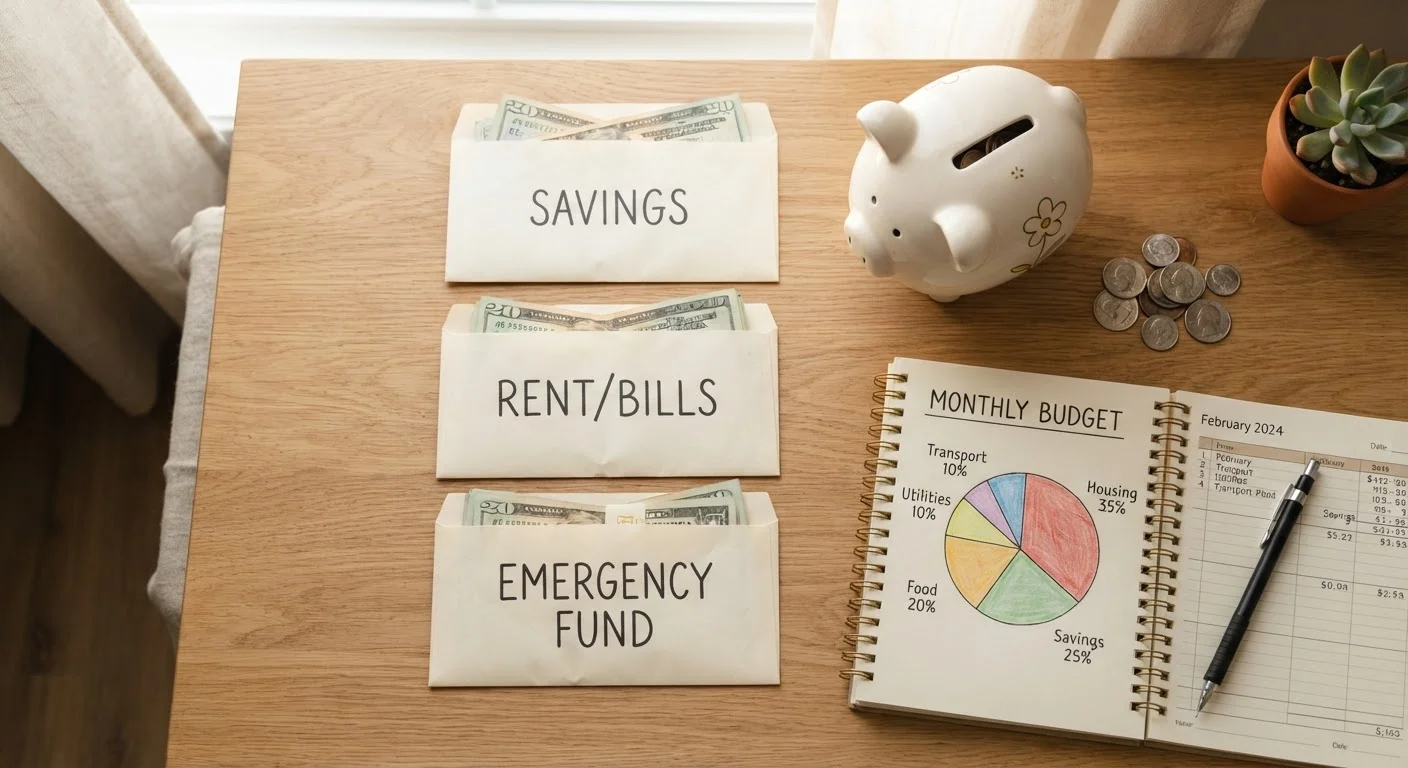
The envelope method assigns a fixed dollar amount to each spending category — groceries, gas, dining out, entertainment — either in literal cash envelopes or through a digital equivalent. When an envelope is empty, spending in that category stops for the month.
Its strength is psychological clarity. There's no ambiguity about whether you can afford another dinner out; you either have money in the envelope or you don't. This makes it particularly effective for people who tend to rationalize overspending or lose track of where money goes.
The method does require upfront effort. You need to estimate realistic category amounts, revisit them as expenses shift, and decide what to do when one envelope runs out before another. It can also be cumbersome for households with many spending categories or irregular income. If your paycheck varies month to month, budgeting on an irregular income requires some extra adaptation before the envelope structure becomes practical.
| Envelope Method | Pay-Yourself-First | Proportional Budgeting | |
|---|---|---|---|
| Core principle | Spend only what's in each category | Save first, spend the rest | Allocate income by percentage |
| Best for | Overspenders needing firm limits | Savings-focused individuals | Those wanting flexible structure |
| Setup effort | High — requires detailed categories | Low — one automated transfer | Medium — set percentage targets |
| Ongoing maintenance | High — track each envelope | Low — review periodically | Low to medium — monthly check-in |
| Works with irregular income | Harder — requires adaptation | Yes — save a percentage, not fixed sum | Yes — amounts adjust with income |
| Savings discipline built in | Only if envelope created for savings | Yes — central to the method | Yes — one percentage category |
| Visibility into spending detail | High — granular by category | Low — spending is largely untracked | Medium — broad categories only |
Pay-Yourself-First: Save Before You Spend
Pay-yourself-first flips the traditional budgeting sequence. Instead of spending throughout the month and saving whatever remains, you transfer a set amount to savings — or toward a financial goal — the moment income arrives. Everything left over is available for expenses.
This method is powerful precisely because it removes savings from the competition with discretionary spending. Automating the transfer makes it even more effective, since the decision is made once rather than reliably every payday.
The trade-off is that it provides limited guidance for the spending side of the budget. If your remaining income doesn't stretch far enough to cover fixed bills and variable expenses, a pay-yourself-first approach alone won't resolve that tension. It pairs well with a basic spending framework, and it's a natural bridge toward building a saving and investing habit once cash flow stabilizes.
Proportional Budgeting: Percentages Over Precision
Proportional budgeting — sometimes called percentage-based budgeting — divides take-home income into broad categories by percentage rather than exact dollar amounts. The widely referenced 50/30/20 framework, for example, allocates roughly 50% to needs, 30% to wants, and 20% to savings and debt repayment. Other splits exist, and the percentages can be adjusted to reflect personal priorities.
The appeal here is simplicity and adaptability. As income rises or falls, the dollar amounts adjust automatically while the structure stays intact. There's no envelope to refill or savings transfer to calculate from scratch each month. That flexibility makes it a common starting point for people new to budgeting or those who find granular tracking discouraging.
The downside is that broad categories can mask problem areas. If the "needs" bucket routinely swells past 50%, the framework doesn't automatically flag which specific expenses are responsible. For people who want to dive deeper into how proportional budgeting compares with more prescriptive alternatives, comparing the 50/30/20 rule with zero-based budgeting offers a useful side-by-side breakdown.
Choosing — or Combining — Methods
Many effective budgeters don't use a single method in pure form. A common hybrid: apply pay-yourself-first for savings automation, then use proportional categories to govern remaining spending, while reserving envelope-style limits for one or two categories that have historically caused overspending.
Tracking style also matters. Whether you track by hand or use a spreadsheet can influence which method feels sustainable. The envelope method, for instance, often works best with a tangible or visual system, while proportional budgeting lends itself to a simple monthly spreadsheet review.
If you share finances with a partner, method choice becomes more important still — different money personalities can create friction around any system. Building a shared budget without conflict often starts with agreeing on a framework both people find intuitive. Before settling on any approach, it's also worth examining common budgeting myths that may be shaping your assumptions about what's possible.