
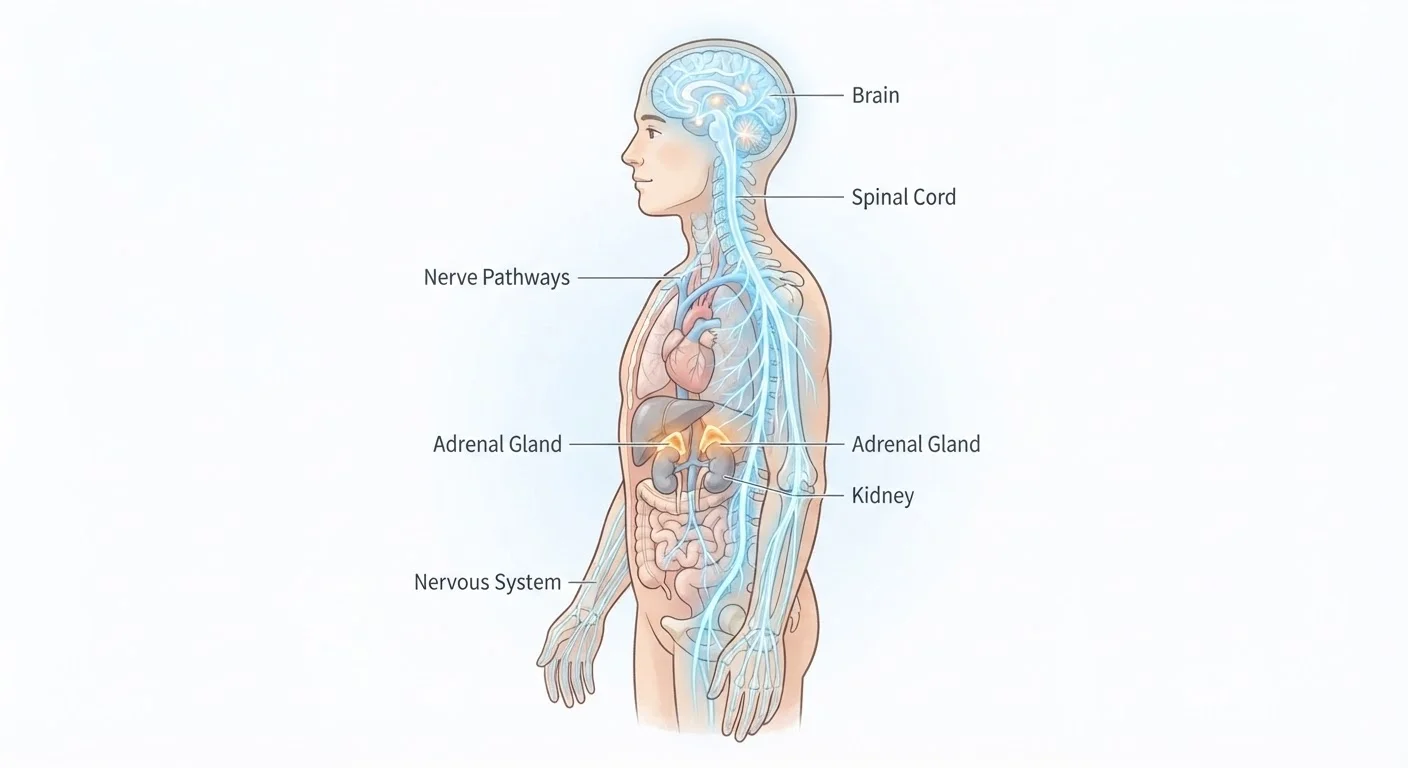
The Moment Stress Begins: A Two-Path System
When your brain perceives a threat — whether it's an oncoming car, a difficult conversation, or a looming deadline — it sets off two rapid biological pathways simultaneously.
The first is the sympathetic-adrenal-medullary (SAM) axis, which acts in seconds. The hypothalamus, a small region at the base of the brain, sends signals through the nervous system directly to the adrenal glands, which sit atop the kidneys. Those glands release adrenaline (epinephrine) into the bloodstream almost instantly. Your heart rate accelerates, your airways open to take in more oxygen, your pupils dilate, and blood is redirected away from digestion and toward your large muscle groups.
The second pathway — the hypothalamic-pituitary-adrenal (HPA) axis — is slower but longer-lasting. The hypothalamus triggers the pituitary gland to release a hormone that instructs the adrenal glands to secrete cortisol. Cortisol sustains the response over minutes and hours, keeping blood sugar elevated and inflammation temporarily suppressed so the body can keep performing under pressure.
Together, these two systems are why stress feels so physical — because it genuinely is.
What Changes in Your Body — and Why
The stress response produces a recognizable set of physical changes, each serving a specific purpose rooted in survival:
- Increased heart rate and blood pressure: More blood reaches the muscles and brain, supporting rapid movement and sharp thinking.
- Faster breathing: The lungs take in more oxygen to fuel the body's heightened activity.
- Muscle tension: Muscles prime themselves for action — which is why stress often shows up as tightness in the neck, shoulders, or jaw.
- Slowed digestion: The body temporarily deprioritizes non-urgent functions, including the digestive system, to conserve energy for immediate needs.
- Heightened alertness: The brain's threat-detection center, the amygdala, becomes more reactive, and non-essential cognitive tasks take a back seat to survival-focused processing.
77%
Americans reporting physical stress symptoms
According to the American Psychological Association's Stress in America survey, a substantial majority of U.S. adults regularly experience physical symptoms they attribute to stress.
~20 min
Typical duration of acute cortisol surge
Research in psychoneuroendocrinology indicates cortisol levels typically peak within 20–30 minutes of a stressor and gradually decline once the perceived threat is resolved.
3x
Higher cardiovascular risk with chronic stress
Some longitudinal studies have found that individuals with persistently high stress levels may face meaningfully elevated cardiovascular risk compared to those with lower chronic stress.
These changes are not malfunctions. They are the body doing exactly what it was designed to do. The problem arises only when the system stays activated for too long.
When the Response Becomes Chronic
Acute stress — the kind tied to a specific, time-limited event — resolves naturally. Once the threat passes, the parasympathetic nervous system (sometimes called the "rest and digest" system) gradually brings the body back to baseline. Heart rate slows, breathing deepens and steadies, and cortisol levels fall.
Chronic stress is different. When psychological pressure is sustained — through ongoing work demands, financial strain, relationship difficulties, or persistent worry — the HPA axis continues producing cortisol without adequate recovery time. Research has associated prolonged cortisol elevation with disrupted sleep, changes in immune function, digestive discomfort, and shifts in mood and memory.
It's worth understanding that experiencing these effects doesn't reflect a personal failing. The body is responding exactly as it evolved to — but to a modern environment full of stressors that don't resolve the way a physical threat would.
This article is for general informational and educational purposes only and does not constitute medical advice. If you are experiencing significant stress-related symptoms, please speak with a qualified healthcare professional.
Why This Knowledge Matters for Mental Health
One of the most useful things a person can know about stress is that its physical symptoms — a racing heart before a presentation, a tightened stomach before a difficult conversation — are not signs that something is wrong with them. They are the body's intelligent response to perceived challenge.
Understanding the biology behind stress can meaningfully reduce the shame and confusion that often accompany it. When people recognize these sensations as a normal physiological process rather than a personal weakness, they're better positioned to respond thoughtfully rather than react anxiously.
The Stress Response Is Neutral — Context Is Everything
The same biological cascade that makes stress feel overwhelming before a difficult conversation is also what sharpens an athlete's focus before competition. Researchers sometimes call this 'challenge versus threat' appraisal — the body's response is similar, but the interpretation shapes the experience and outcome. This doesn't mean you can simply think your way out of chronic stress, but it does suggest that context and perception play a meaningful role in how the stress response affects you.
Evidence-based approaches — including regular physical activity, consistent sleep, mindfulness practices, and social connection — are known to support the body's stress-regulation systems. For stress that feels persistent or overwhelming, a licensed mental health professional or physician can offer assessment and targeted support. Reducing stigma starts with understanding: your body's stress response is a feature, not a flaw.