More Than a Court: How the Supreme Court Shapes Governance
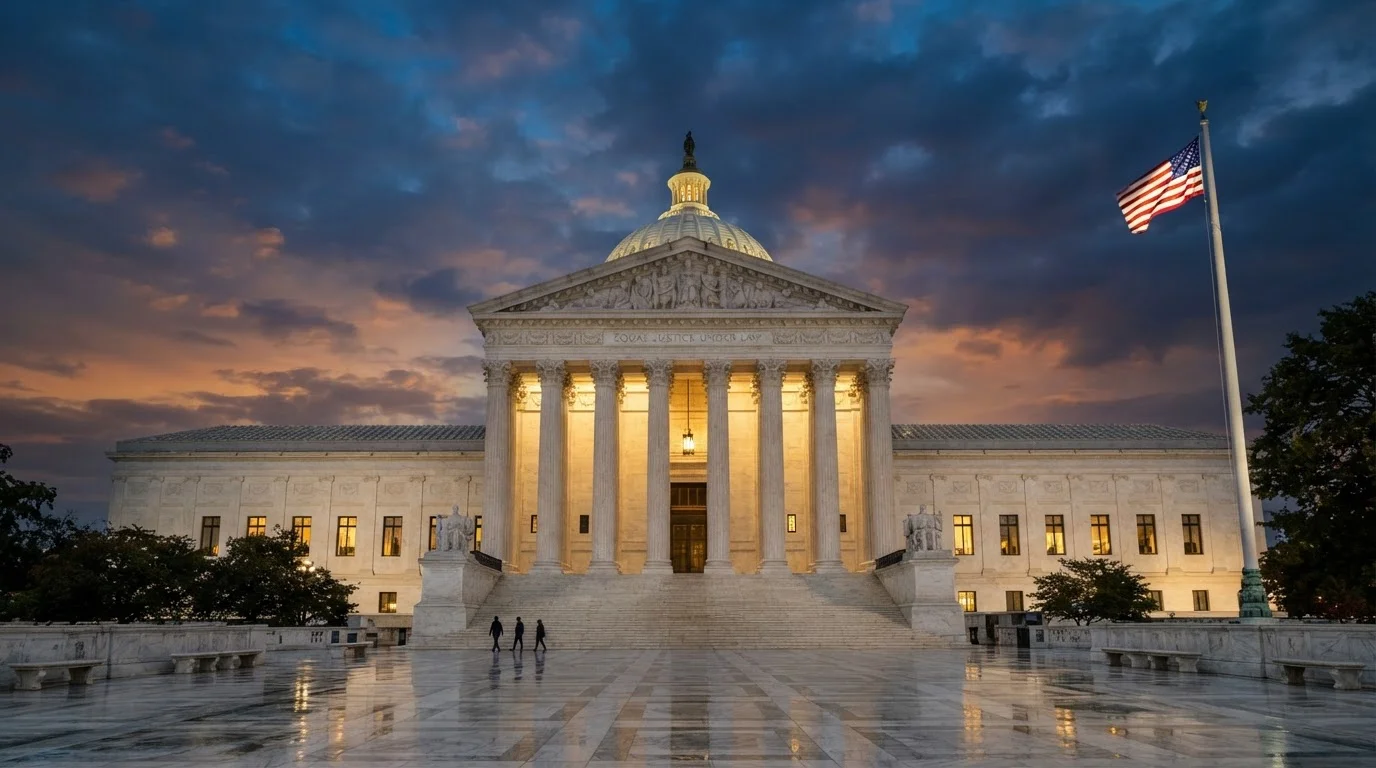
Most Americans know the Supreme Court as the place where major legal battles end. But its function in American democracy runs considerably deeper than resolving disputes between parties. The Court acts as a constitutional referee — deciding whether the laws Congress writes and the actions presidents take stay within the boundaries the Constitution allows.
This power of judicial review means the Court can invalidate virtually any law in the country, from a state ballot measure to a sweeping act of Congress. It has used that authority to reshape American life on questions of racial equality, free speech, reproductive rights, and the limits of executive power. To understand why so many political battles eventually land at the Court's doorstep, it helps to understand what the Court actually does — and what it doesn't.
For a broader look at how political terms like these fit into the wider system, see our plain-language guide to political vocabulary.
Confirmation Battles: Why Every Vacancy Becomes a Political Crisis
Under the Constitution, the president nominates Supreme Court justices and the Senate confirms them. In practice, that process has become one of the most politically charged events in American civic life. Because justices serve lifetime appointments — with no mandatory retirement age — a single vacancy can alter the ideological direction of the Court for 20 or 30 years.
Senators of both parties have increasingly treated confirmations as high-stakes opportunities to cement policy outcomes on issues the Court may rule on in the future. Hearings stretch for days, nominees face exhaustive questioning, and floor votes sometimes fall almost entirely along party lines. The 2016 vacancy left open for nearly a year after Justice Antonin Scalia's death — and the compressed confirmation of Justice Amy Coney Barrett days before the 2020 presidential election — illustrated how dramatically norms around the process can shift.
~60–80
Cases heard by the Court each term
Out of roughly 7,000–8,000 petitions filed annually, the Supreme Court typically agrees to hear only a small fraction, according to the Court's own published statistics.
28 years
Average tenure of recent justices
Research from legal scholars has found that the average length of service for justices appointed since the 1970s has grown substantially compared to earlier eras, amplifying the stakes of each nomination.
1803
Year judicial review was established
The landmark Marbury v. Madison decision, authored by Chief Justice John Marshall, established the Court's authority to strike down laws that conflict with the Constitution — a power it has exercised ever since.
Understanding confirmation fights requires understanding how the Court fits within the broader system of checks and balances between branches.
The Shadow Docket: Big Decisions Made Quietly
When most people picture the Supreme Court at work, they imagine oral arguments — lawyers presenting cases before nine justices, followed months later by detailed written opinions. That is the Court's standard, highly visible process. But a growing share of consequential decisions now happen through what legal scholars call the shadow docket.
The shadow docket refers to emergency orders and other rulings issued outside the normal briefing and argument schedule, often with minimal explanation. These orders can block or reinstate major federal policies while litigation continues in lower courts — affecting millions of people with little public deliberation. Immigration enforcement rules, pandemic-related mandates, and election procedures have all been shaped by shadow docket orders in recent years.
Critics across the political spectrum argue that this practice reduces transparency and accountability. Defenders say emergency orders are sometimes genuinely necessary to prevent irreversible harm while cases work through the courts. The debate over the shadow docket reflects a broader tension between the Court's institutional independence and public expectations of openness.
Landmark Rulings and Their Long Political Reach
The Supreme Court's decisions do not expire with the case that produced them. They become the law of the land — binding on every lower court, every legislature, and every executive agency until the Court itself revisits the question or a constitutional amendment changes the underlying framework.
This staying power means rulings from decades past still define current policy. Brown v. Board of Education (1954) dismantled legal school segregation. Roe v. Wade (1973) established a federal right to abortion that stood for nearly 50 years before the Court's 2022 Dobbs decision overturned it, returning the question to individual states. Citizens United v. FEC (2010) expanded First Amendment protections for political spending by corporations and other groups, reshaping campaign finance law.
Each of these decisions — and many others — illustrates why pivotal moments in U.S. political history continue to echo through current debates. The Court does not simply react to politics — through its rulings, it actively defines the terrain on which political fights are waged.
The Court and Public Trust
Unlike the presidency or Congress, the Supreme Court has no army, no budget authority, and no elected mandate. Its influence rests almost entirely on public legitimacy — the broadly shared belief that its rulings carry binding authority and reflect principled legal reasoning rather than raw political preference.
Polling has shown that public confidence in the Court can fluctuate with high-profile decisions and controversies over justices' conduct. When the institution is perceived as driven by partisan outcomes rather than constitutional interpretation, that perception carries real consequences: it shapes how seriously legislators, executives, and ordinary citizens treat Court rulings as legitimate constraints.
The Court's independence from electoral politics is both its defining strength and an ongoing source of tension in a democracy where accountability is a core value. How Americans navigate that tension — through elections, legislative action, and public debate — is itself a measure of the system's health.