The Core Question: What Are You Actually Comparing?
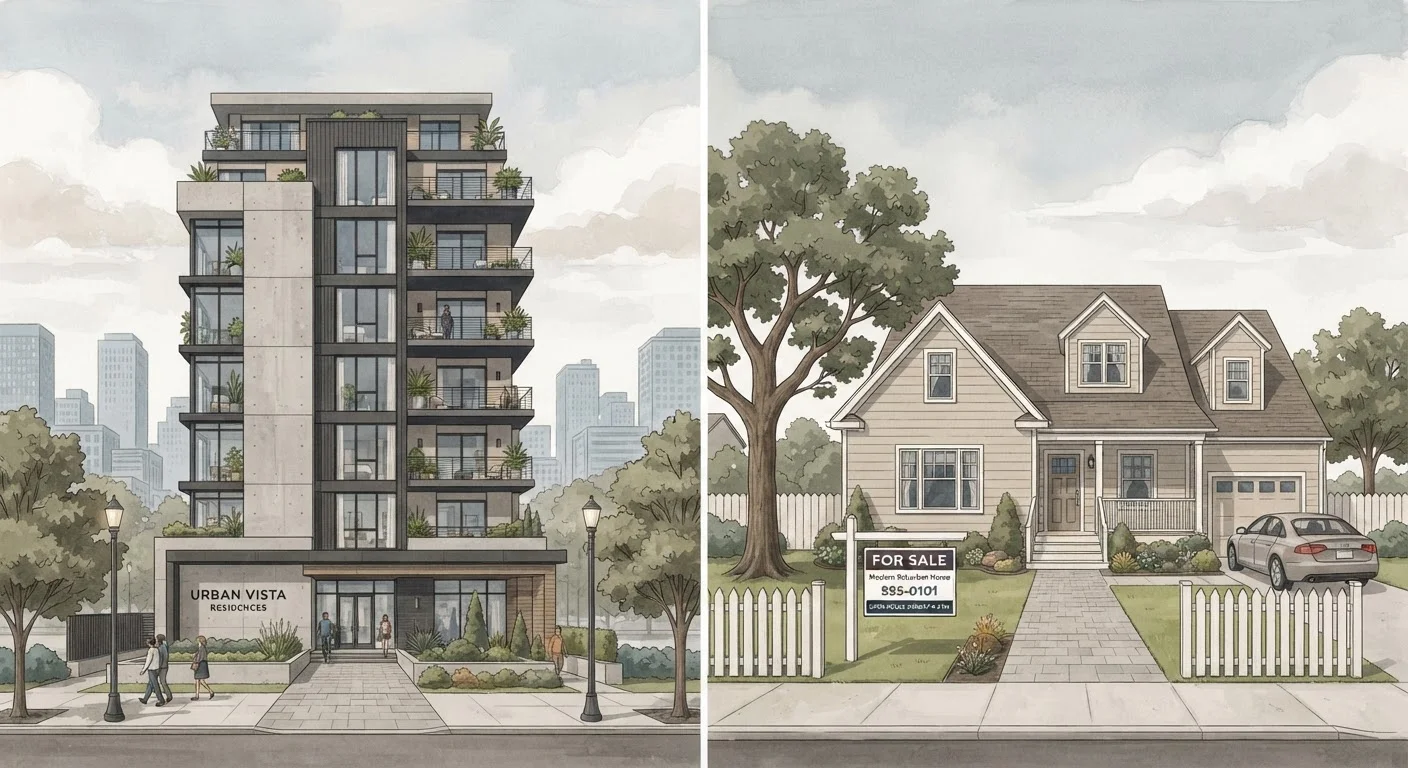
The renting-vs-buying debate is often framed as a financial question, but it is really several questions layered together: How long will you stay? How stable is your income? What does your local housing market look like? What lifestyle do you want?
Treating buying as automatically smarter than renting — or vice versa — glosses over real differences that vary person to person. This comparison is designed to lay out those differences clearly so you can apply them to your own situation. For a deeper look at what ownership actually involves beyond building equity, see our article on the real trade-offs of renting vs. owning.
| Renting | Buying | |
|---|---|---|
| Upfront costs | Security deposit + first month's rent | Down payment + closing costs (often 5–25% of price) |
| Monthly cost predictability | Can rise at lease renewal | Fixed-rate mortgage stays constant |
| Maintenance responsibility | Landlord typically handles repairs | Owner pays all maintenance costs |
| Equity building | None in the property | Builds with each mortgage payment |
| Flexibility to relocate | High — especially month-to-month | Low — selling takes time and money |
| Customization | Limited by landlord rules | Full control to renovate or modify |
| Best time horizon | Short to medium term (under 5 years) | Long term (5+ years in same location) |
Financial Factors: Upfront Costs, Monthly Expenses, and Long-Term Wealth
Buying a home requires significant cash before you move in. A down payment typically ranges from 3% to 20% of the purchase price, and closing costs generally add another 2% to 5%. On a $350,000 home, that is potentially $17,500 to $87,500 needed upfront — before any moving costs or immediate repairs.
Renting, by contrast, usually requires a security deposit and first month's rent. That difference in upfront cash can matter a great deal for someone earlier in their financial life.
Monthly costs also differ in ways that are easy to underestimate. A mortgage payment is predictable, but homeownership adds property taxes, homeowner's insurance, HOA fees (where applicable), and maintenance. Maintenance alone is commonly estimated at 1% to 2% of a home's value per year — meaning a $350,000 home might require $3,500 to $7,000 annually for upkeep. For a fuller breakdown of what those ongoing costs look like, see the financial realities buyers often underestimate.
Renters do build no equity in the property, but they retain the flexibility to invest the difference in cash — including money that would have gone toward a down payment. Whether renting or buying comes out ahead financially depends heavily on local home price growth, investment returns, and how long you stay.
Flexibility vs. Stability: Lifestyle Considerations That Matter
One of renting's most underrated advantages is mobility. A lease — especially a month-to-month arrangement — lets you relocate for a job, relationship change, or personal preference without the complexity of selling a home. Selling takes time, costs money (agent commissions alone often total 5%–6% of the sale price), and is subject to market conditions you cannot control.
Homeownership, on the other hand, provides a kind of stability that renters don't have. Landlords can raise rent, decline to renew a lease, or sell the property. Fixed-rate mortgage payments stay the same for the life of the loan — a meaningful hedge against rising housing costs over time.
There is also a lifestyle dimension: owners can renovate, paint, and customize without asking permission. Renters must generally restore the property to its original condition and are subject to landlord rules about pets, alterations, and subletting. If you are currently renting and weighing your options, this guide for first-time tenants covers the full picture of what to expect as a renter.
Timing and Market Conditions: When the Math Shifts
How long you plan to stay may be the single most important variable in this decision. Buying typically makes more financial sense the longer you remain in a home. Transaction costs on both ends of a sale are high enough that short-term ownership can result in a net loss even if the home appreciates modestly. Many financial planners suggest a rough benchmark of five to seven years before buying tends to break even with renting — though this varies significantly by market.
Local conditions matter too. In some markets, monthly mortgage payments on a comparable property can be substantially higher than rent. In others, the reverse is true. The price-to-rent ratio — roughly, the home's purchase price divided by annual rent for a similar home — is one way to assess which path is more favorable in a given area, though it is a starting point, not a complete answer.
Interest rates also shape the comparison. Higher rates increase monthly mortgage payments, which narrows the financial advantage of buying compared to renting in the same market. Conversely, when rates are lower, buying becomes relatively more attractive on a monthly-cost basis.
This article is for general informational and educational purposes only and does not constitute financial, tax, or legal advice. Housing decisions involve complex personal and financial factors. Consult a qualified financial adviser, lender, or real estate professional before making decisions about buying or renting a home.