What Each Lease Type Actually Means
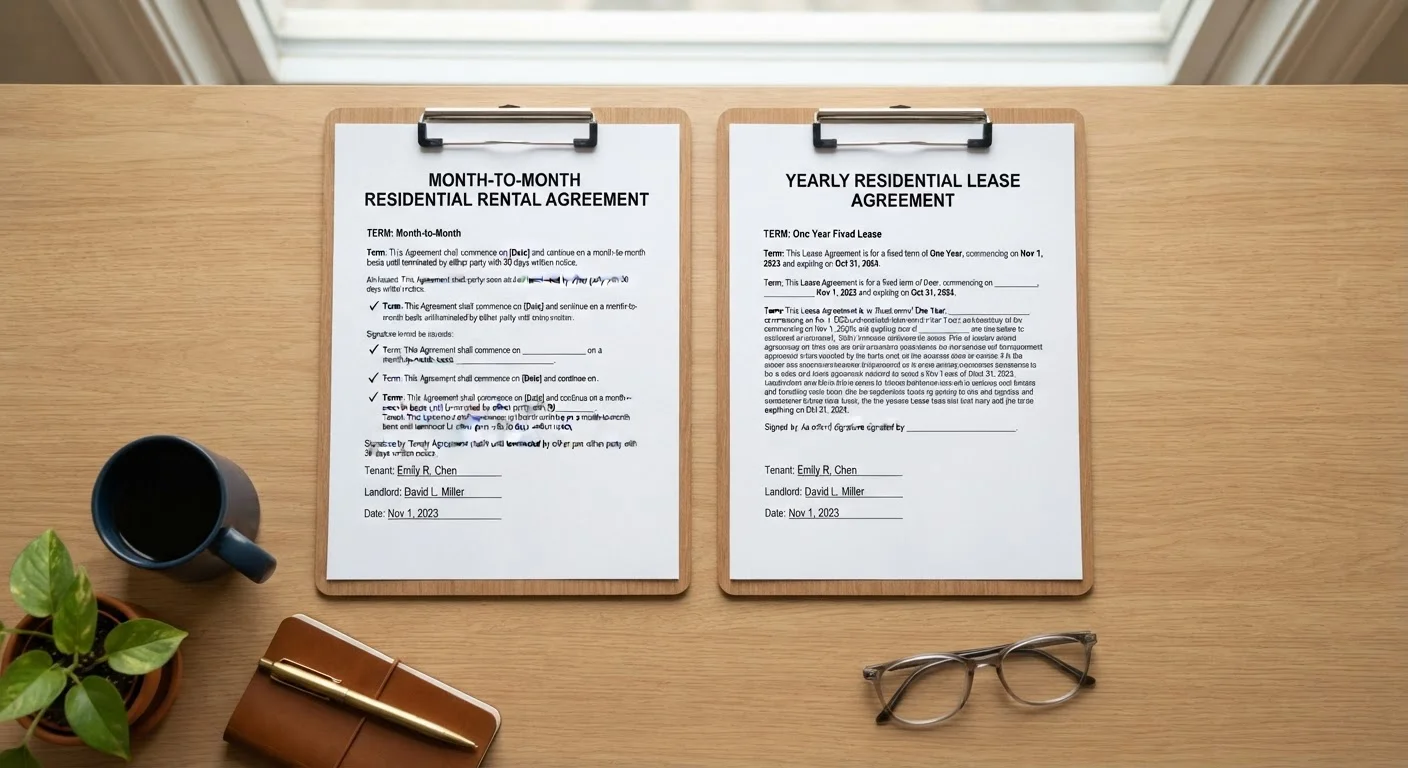
A fixed-term lease is a rental agreement that runs for a defined period — most commonly 12 months — with a set monthly rent, a clear start date, and an end date. Both tenant and landlord are legally bound for the full term. Breaking that agreement early can trigger financial penalties, which are worth understanding before you sign. Our guide on breaking a lease early explains the consequences, exceptions, and how to negotiate if you need out.
A month-to-month lease, by contrast, renews automatically each month. Either the tenant or the landlord can end the arrangement — typically with 30 days' written notice, though this varies by state. There's no locked-in end date, but there's also no guaranteed continuity. Landlords in many states can raise rent or terminate tenancy with proper notice at each renewal cycle.
Both lease types are governed by a written agreement that outlines your rights and responsibilities. Before signing either, it's worth reviewing what the clauses actually mean. Our resource what a lease agreement actually says walks through the key terms renters should examine carefully.
Head-to-Head: Key Differences at a Glance
The chart below compares both lease types across the dimensions that matter most to renters making a housing decision.
| Criterion | Month-to-Month Lease | Fixed-Term Lease |
|---|---|---|
| Commitment length | Renews monthly, no set end | Defined term, typically 12 months |
| Rent stability | Can change each renewal cycle | Locked in for the full term |
| Tenant flexibility to exit | 30-day notice in most states | Penalties apply for early exit |
| Landlord's right to terminate | 30-day notice in most states | Cannot terminate without cause mid-term |
| Typical monthly cost | Often higher than fixed-term rate | Usually lower; landlord rewards commitment |
| Availability | Not always offered; market-dependent | Standard offering in most markets |
| Best planning horizon | Short-term or uncertain timelines | Stable, predictable living situations |
One detail the table doesn't capture: month-to-month leases are not universally available. In high-demand rental markets, many landlords prefer fixed-term tenants for income predictability and may not offer a rolling arrangement at all — or may charge a meaningful premium for it.
The Real Cost of Flexibility
Month-to-month arrangements are often marketed as a perk, and for many renters they genuinely are. But flexibility carries a price that isn't always obvious upfront.
Landlords who offer month-to-month terms typically charge more per month — sometimes 10–25% above the rate they'd offer on a 12-month lease — to offset the uncertainty of unpredictable vacancy. If you're comparing a $1,500/month fixed lease against a $1,700/month rolling one, the $200 monthly gap adds up to $2,400 over a year. That's real money to weigh against the option to leave on short notice.
There's also the security dimension. Under a fixed-term lease, your landlord generally cannot raise your rent or end your tenancy before the term expires without cause. Month-to-month tenants have no such protection at each renewal cycle. In practice, this means your housing situation can change with a single month's notice — which matters most in markets where finding a comparable unit quickly is difficult.
State Laws Govern Notice Requirements
The 30-day notice standard is common but not universal. Some states require 60 days' notice to terminate a month-to-month tenancy, and local rent-control ordinances can add further protections or restrictions. Before signing any lease, check the specific rules in your state and city. Tenant rights organizations and state attorney general offices are good starting points for accurate local information.
If you're weighing whether to rent at all versus pursuing ownership, see our balanced breakdown: renting vs. buying a home.
When a Fixed-Term Lease Is the Smarter Move
If your job, family situation, and preferred location are stable, a fixed-term lease offers protections that a rolling arrangement simply can't match. You know exactly what you'll pay each month, you can't be displaced without cause mid-term, and you have a clear planning horizon — useful for everything from saving goals to school enrollment.
Fixed-term leases also give renters more negotiating leverage upfront. Landlords who see a committed, long-term tenant may be willing to negotiate on move-in costs, minor upgrades, or lease terms. Once you're month-to-month, that initial negotiating window has closed.
The primary risk is being locked in. Life changes — a job loss, a new relationship, a need to relocate — can make a fixed term feel like a trap. That's why reading the early-termination clause carefully before signing matters enormously. Some leases allow buyout provisions; others impose penalties equal to two or three months' rent.
Making the Decision: A Practical Framework
Rather than defaulting to whichever option a landlord presents first, consider your situation against three honest questions:
- How confident are you in your timeline? If you expect to stay at least 12 months, a fixed-term lease is usually the financially sound choice. If there's genuine uncertainty, flexibility may be worth the premium.
- How tight is the local rental market? In competitive cities, locking in a unit at a known rate shields you from having to re-enter a difficult market. In softer markets, the calculus shifts.
- What does the lease actually say? Both types of leases vary significantly in their details. Notice periods, rent-increase provisions, subletting rights, and exit terms all affect your real-world flexibility regardless of lease type. See our guide to subletting if that's a factor in your decision.
There's no universal right answer — but there is a right answer for your specific circumstances. A little time spent reading the agreement and assessing your own timeline can prevent a costly mismatch between your lease and your life.
This article is for general informational purposes only and does not constitute legal or financial advice. Lease laws vary by state and locality. Consult a qualified attorney or licensed property professional for guidance specific to your situation.