The Core Question: What Are You Actually Comparing?
The debate between renting and buying often gets framed as a moral one — as if choosing to rent means you're wasting money and buying means you're responsible. Neither framing is accurate. Both are legitimate housing strategies with real advantages and real drawbacks.
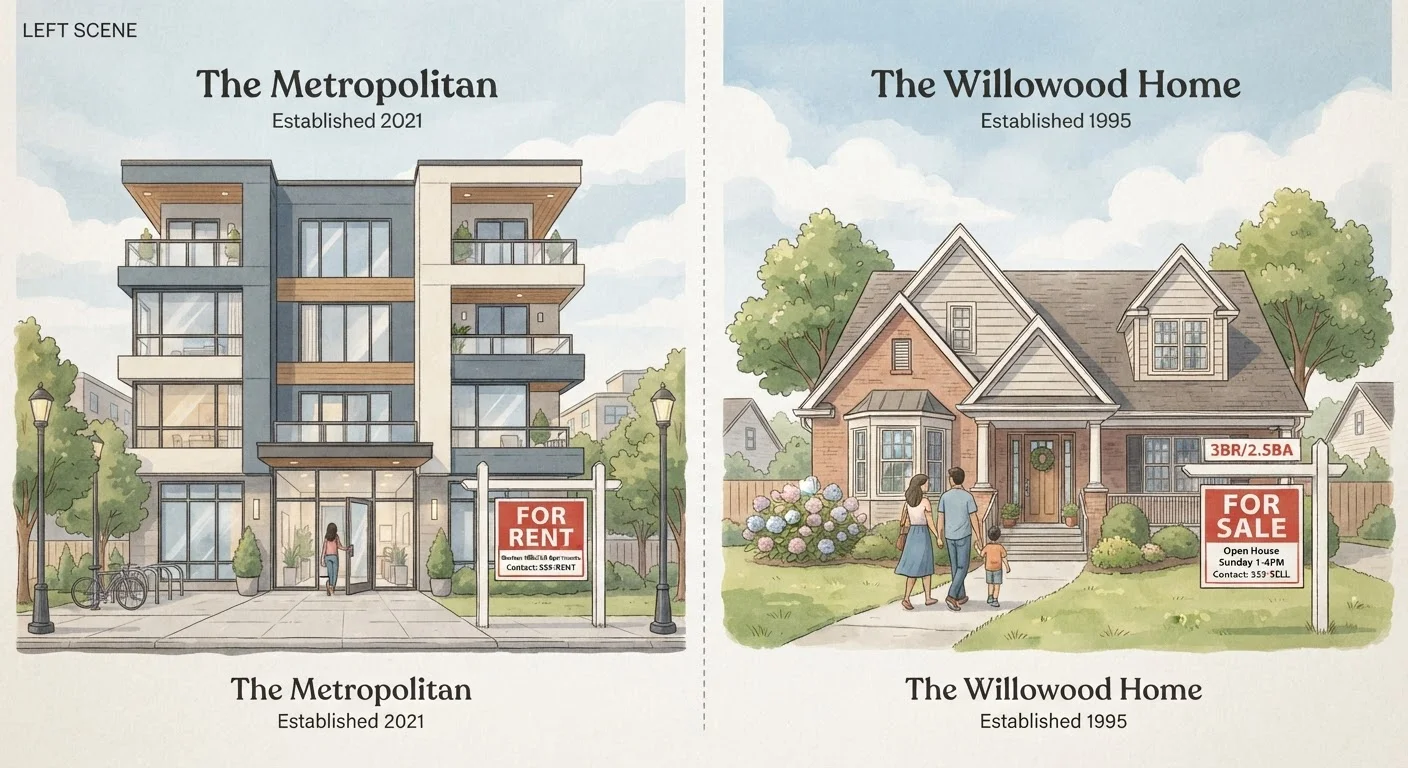
What you're actually comparing is a set of trade-offs: liquidity versus equity, flexibility versus stability, predictable monthly costs versus the potential for long-term appreciation. The right answer depends on your financial situation, how long you plan to stay, your local market, and what you value in your daily life.
For a deeper look at how these trade-offs play out over time, see this side-by-side comparison of renting and buying across financial and lifestyle factors.
The Advantages of Renting
Renting is often dismissed as a temporary or inferior housing choice, but it offers genuine benefits that buying cannot match — especially in certain life stages or markets.
Lower upfront financial commitment
Renters typically pay a security deposit and first month's rent to move in, compared to tens of thousands of dollars in down payment and closing costs for buyers. This preserves cash for other goals.
Flexibility to relocate without major financial consequences
Ending a lease (with proper notice) is far simpler than selling a home. This matters for people whose jobs, relationships, or life plans might change.
No exposure to maintenance costs or major repairs
When the furnace breaks or the roof leaks, the landlord is generally responsible for repair costs. Renters avoid the unpredictable expense spikes that homeowners regularly face.
Predictable monthly housing costs
A fixed lease locks in rent for its term, making it easier to budget. Renters are not exposed to property tax increases or emergency repair bills.
Renters also avoid the financial exposure that comes with owning in a volatile market. If home values fall after you buy, you carry that loss. If values rise after you rent, you're insulated from a purchase made at the wrong time. For renters wanting to understand their rights and the full scope of what renting involves, this complete guide for first-time tenants covers everything from applications to move-out.
The Advantages of Buying
Homeownership does offer meaningful benefits — particularly for people with stable finances, a long-term commitment to an area, and enough savings to cover the upfront costs comfortably.
Builds equity that can grow over time
Each mortgage payment reduces your loan balance, and if home values increase, that equity represents real wealth. Renters make no equivalent gain from their monthly payments.
Provides stability and control over your living space
Owners cannot be displaced at a landlord's discretion. You can renovate, adopt pets, and make the space your own without seeking permission.
Fixed-rate mortgage locks in a predictable payment
Unlike rent, which can increase at renewal, a fixed-rate mortgage keeps principal and interest constant for the life of the loan — providing long-term cost stability.
Potential tax benefits in some situations
Mortgage interest and property taxes may be deductible for some homeowners who itemize deductions, though tax outcomes vary significantly by individual situation. Consult a tax professional for guidance specific to your circumstances.
Ownership also provides a degree of control over your living space that renting rarely allows: renovations, pets, and personalization are generally at your discretion. And for those who stay in a home long enough, a fixed-rate mortgage locks in a predictable principal-and-interest payment for the life of the loan — while rent can increase at lease renewal. For a realistic picture of what it actually means to own a home, it's worth understanding the legal and financial responsibilities that start on closing day.
The Costs Buyers Often Underestimate
One of the most common mistakes first-time buyers make is comparing their mortgage payment to their rent payment as if those are equivalent. They are not.
Your Mortgage Payment Is Not Your Full Housing Cost
When comparing renting to buying, the mortgage principal and interest is only part of what you'll pay each month. Property taxes, homeowner's insurance, possible HOA dues, and maintenance costs all add to the real monthly expense. Before concluding that buying is cheaper than renting in your area, add these costs to the mortgage payment for a true comparison.
Property taxes, homeowner's insurance, private mortgage insurance (if your down payment is under 20%), HOA fees, and routine maintenance all add to the true monthly cost of ownership. A commonly cited rule of thumb is to budget 1–2% of a home's value annually for maintenance alone — on a $350,000 home, that's $3,500 to $7,000 per year, or roughly $290 to $580 per month on top of your mortgage.
This breakdown of the financial realities buyers often underestimate covers these ongoing expenses in depth. Additionally, common homeownership myths — like the idea that a bigger down payment is always better — can trip up even well-prepared buyers.
How Long You Stay Changes Everything
The single most important variable in the rent-vs.-buy calculation is how long you plan to remain in the home. Buying involves significant upfront costs — a down payment (typically 3–20% of the purchase price), closing costs (often 2–5% of the loan amount), moving expenses, and immediate repairs or furnishings.
5–7 years
Minimum stay often needed to break even on buying
Most financial analysts and housing economists suggest buyers need at least five to seven years in a home before purchase costs are typically recovered through equity and avoided rent increases.
2–5%
Typical closing costs as a share of loan amount
The Consumer Financial Protection Bureau notes that closing costs commonly range from 2% to 5% of the loan amount, adding thousands to the upfront cost of buying.
Those costs take time to recoup. Most financial analyses suggest a buyer needs to stay in a home for at least five to seven years before the costs of purchasing begin to be offset by equity gains and the avoidance of rising rent. If your job, family situation, or preferences might take you elsewhere in two or three years, renting is likely the more financially sound choice — even if you can afford to buy.
Renters who want flexibility in lease length should also consider month-to-month vs. fixed-term lease options to match their housing arrangement to their actual plans.