Why Currency Myths Are Costing You Real Money
International travel is full of small financial decisions that seem trivial in the moment but add up fast. Paying a bad exchange rate here, accepting a convenience fee there — by the time you get home, hundreds of dollars may have quietly slipped away. The frustrating part? Most of these losses stem from widely repeated myths rather than deliberate choices.
Currency exchange is one of the least-understood corners of travel finance. Banks, kiosks, card networks, and local merchants all profit differently from the same transaction, and the rules aren't posted clearly. That murky environment is exactly where myths thrive. Currency pitfalls are just one category of overlooked travel expenses — but they're among the most preventable.
Below, we break down the most persistent myths and replace them with what actually happens at the exchange counter, the ATM, and the point of sale.
Myth
Airport currency exchange kiosks are the safest and most convenient place to get foreign cash.
Fact
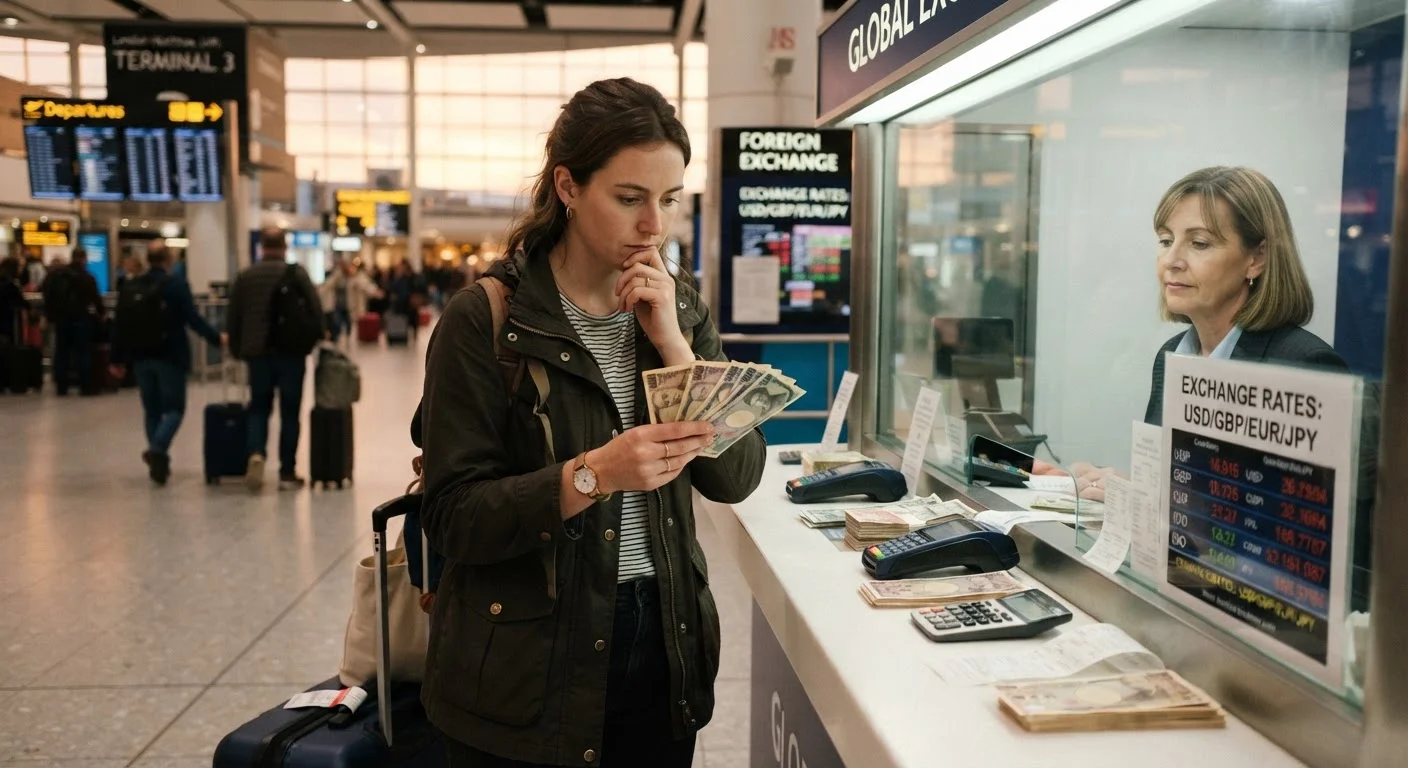
Airport kiosks are convenient, but they routinely offer exchange rates significantly worse than alternatives like in-network ATMs or your home bank.
The appeal of airport kiosks is obvious — you land, you exchange, you're ready to go. But that convenience comes at a steep cost. Kiosks at airports and tourist hubs typically build their profit into a wide spread between the interbank (mid-market) rate and what they offer customers. The posted rate may also look reasonable until you factor in the flat service fee on top. If you need a small amount of local cash on arrival, withdrawing from an airport ATM affiliated with a major bank is generally a better starting point — though fees still vary by card and institution, so check your bank's terms before you travel.
Myth
Dynamic currency conversion (DCC) is helpful because you can see the charge in U.S. dollars.
Fact
Dynamic currency conversion almost always results in a worse exchange rate than your card network's rate, costing you extra on every transaction.
When a foreign merchant or ATM offers to convert your purchase into U.S. dollars on the spot, that process is called dynamic currency conversion. It sounds helpful — you know exactly what you're paying in dollars — but the conversion rate used is set by the merchant's payment processor, not your bank or card network. That rate typically includes a markup of several percentage points. Your card's network rate (Visa, Mastercard, etc.) is almost always more favorable. The correct move, every time: decline DCC and pay in the local currency. The charge in dollars will show up on your statement anyway, converted at the network rate.
Myth
You should exchange all your cash before leaving the United States to get the best rate.
Fact
Pre-trip exchanges at U.S. banks can be competitive, but they're not automatically superior, and carrying large amounts of cash creates unnecessary risk.
Exchanging some cash before departure makes sense for immediate needs — airport transit, a first meal, tips. But the idea that U.S.-based exchange is always the best rate isn't reliable. Rates vary by institution, and some currencies are harder to source domestically, leading to worse spreads. In many destinations, withdrawing from a local ATM as needed offers comparable or better rates while reducing the amount of cash you're traveling with. Carrying large sums of foreign currency also increases your exposure if your wallet is lost or stolen. A practical approach: exchange a modest amount before departure and rely on ATMs for the bulk of your cash needs once you arrive.
Myth
Foreign transaction fees are unavoidable — every card charges them.
Fact
Many credit and debit cards carry no foreign transaction fees at all, and switching to one before your trip is one of the simplest ways to save money abroad.
Foreign transaction fees — typically ranging from 1% to 3% of each purchase — are charged by many cards but far from all of them. A significant number of credit cards marketed toward travelers waive these fees entirely. The same is true for certain debit cards offered by online banks and credit unions. Over the course of a two-week international trip with regular card use, a 3% fee on every transaction adds up to a meaningful sum. Reviewing your card's fee schedule before departure — and potentially applying for a no-foreign-transaction-fee card well ahead of your trip — is one of the highest-return steps you can take. This is general information; card terms change, so verify current terms directly with your card issuer.
Myth
The exchange rate you see online is what you'll actually get at the exchange counter.
Fact
The rate you find via a quick search is the mid-market (interbank) rate — a wholesale benchmark that consumer exchange services rarely match.
The mid-market rate, sometimes called the "real" exchange rate, is the midpoint between global buying and selling prices for a currency pair. It's what banks use to trade with each other, and it's what most currency-tracking websites display by default. Consumer-facing services — exchange kiosks, hotel desks, and even some bank branches — add their margin on top, meaning you'll almost always receive fewer units of foreign currency than the headline rate suggests. When comparing exchange options, ask for the all-in rate including fees rather than relying on the posted rate alone. Hidden costs in travel follow this same pattern: the number you see first is rarely the number you pay.
Building Smarter Habits Before and During Your Trip
Understanding the myths is only half the battle — the other half is turning that knowledge into a practical pre-trip routine. Before you depart, check whether your debit card charges international ATM fees and whether your credit card adds a foreign transaction surcharge. Many credit unions and online banks reimburse ATM fees abroad, and a growing number of travel-oriented credit cards charge zero foreign transaction fees. This is general information — always read your specific card's terms and consider consulting a financial professional for guidance suited to your situation.
Watch Out for Standalone ATMs in Tourist Areas
ATMs operated by independent companies (rather than established local banks) are common near major tourist sites and sometimes charge high flat fees per withdrawal on top of poor exchange rates. They can also carry a higher risk of card-skimming devices. Whenever possible, use ATMs physically attached to a reputable local bank branch and cover the keypad when entering your PIN.
Once you're on the ground, a few habits go a long way. Always withdraw from ATMs attached to established banks rather than standalone machines in tourist zones, where fees and skimming risks tend to be higher. Keep a modest amount of local cash on hand for small vendors, transit, and tips — especially in destinations where card acceptance is inconsistent. And if a merchant or ATM screen asks whether you'd like to pay in U.S. dollars, decline every time.
If you're heading abroad for the first time, a thorough pre-trip planning guide can help you navigate everything from currency logistics to visa requirements. The same critical thinking that protects you from currency myths applies equally to other financial decisions — financial misconceptions at home follow a surprisingly similar pattern.