The Three Numbers That Drive Every Auto Loan
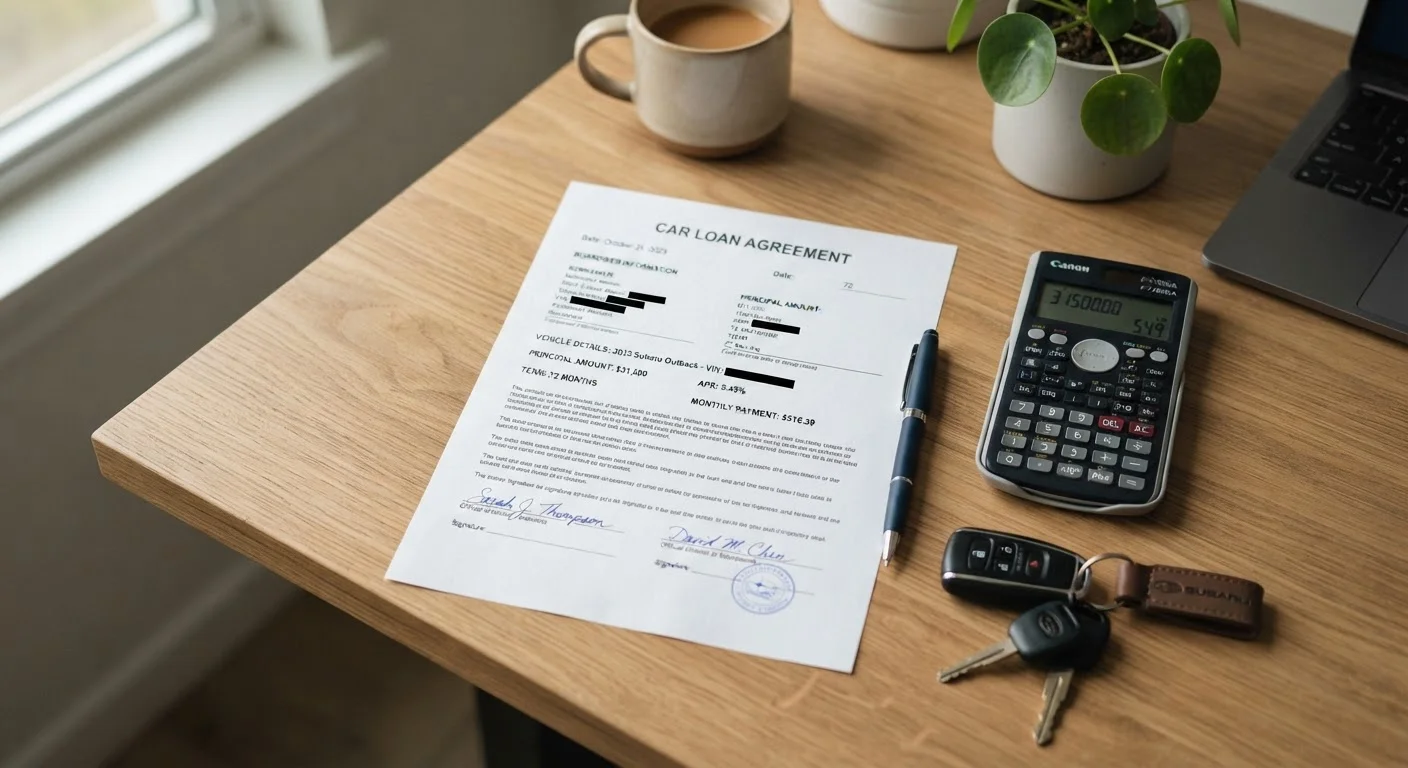
When a lender or dealer quotes you financing, three variables determine how much you'll pay — and how much the loan ultimately costs: the APR, the loan term, and the resulting monthly payment. These numbers are deeply connected. Changing one always affects the others, and understanding those relationships is the most important thing you can do before signing any auto financing agreement.
| Typical auto loan terms | 24–84 months (Common industry range across U.S. lenders) |
| Impact of APR on a $30,000 loan (60 months) | 5% APR ≈ $566/mo vs. 9% APR ≈ $623/mo (Illustrative calculation; actual rates vary by lender and credit profile) |
| Recommended down payment | 10–20% of vehicle price (General financial guidance; not personalized advice) |
| Loan-to-value (LTV) threshold most lenders prefer | Below 100% (Varies by lender; exceeding 100% LTV typically raises rate) |
The Annual Percentage Rate (APR) is the broadest measure of your borrowing cost. Unlike a simple interest rate, APR folds in lender fees, giving you a single percentage you can use to compare offers from different sources — your bank, a credit union, or dealership financing. A lower APR means less money paid to the lender over the life of the loan.
The loan term sets the repayment window. Shorter terms (24–48 months) carry higher monthly payments but substantially less total interest. Longer terms (72–84 months) feel affordable month to month, but the interest accumulates — and the vehicle's value depreciates faster than your balance drops, which creates the risk of negative equity. For a deeper look at how your credit standing shapes the rate you're offered, see our Credit Report Glossary.
How APR, Term, and Payment Interact
Monthly payment is the output of a formula that takes your loan amount (principal minus down payment), divides it by the loan term, and layers in interest calculated from the APR. Lenders use a process called amortization to structure this so early payments are interest-heavy and later payments attack the principal more aggressively.
Annual Percentage Rate (APR)
The yearly cost of borrowing money, expressed as a percentage. It includes the interest rate plus any lender fees, making it a more complete measure of loan cost than the interest rate alone.
Principal
The original amount of money borrowed, before interest is added. Each monthly payment chips away at the principal balance.
Loan Term
The length of time you have to repay the loan, typically expressed in months (e.g., 48, 60, or 72 months). A longer term lowers your monthly payment but increases total interest paid.
Amortization
The process of spreading loan payments over time so each payment covers both interest and principal. Early payments are weighted more toward interest; later payments reduce principal faster.
Down Payment
An upfront cash payment made at the time of purchase that reduces the amount you need to finance. A larger down payment lowers both your monthly payment and total interest cost.
Preapproval
A conditional commitment from a lender stating how much they are willing to lend you and at what rate, based on a review of your credit and finances. It gives you a negotiating benchmark before visiting a dealership.
Dealer Markup
An increase to the interest rate that a dealership may add on top of the lender's base rate when arranging financing. The difference between the buy rate and the rate you are quoted can represent additional dealer profit.
Negative Equity
A situation in which you owe more on the loan than the vehicle is currently worth, sometimes called being 'underwater' or 'upside down' on the loan.
Here's the core tension: a dealership may quote a low monthly payment as evidence of a good deal, but that payment could simply reflect a very long term rather than a low APR. A $35,000 loan at 7% APR over 84 months produces a payment around $528 — but you'll pay roughly $9,400 in interest total. The same loan over 48 months costs about $838 per month but only around $2,200 in interest. Neither option is automatically right; the question is which trade-off fits your budget and financial goals.
Down payments shift the equation favorably. Putting more cash down reduces the amount financed, which lowers both the monthly payment and total interest — without requiring a better rate. It also immediately reduces your loan-to-value ratio, which can make you a more attractive borrower.
If you're weighing whether to finance a purchase or lease instead, the financial language is quite different. Our article on how lease math actually works breaks down money factor, residual value, and capitalized cost in the same plain-language style.
Getting the Best Rate and Avoiding Common Pitfalls
The rate you're quoted is rarely take-it-or-leave-it. Lenders compete, and your credit profile is the primary variable they use to price your loan. A stronger credit history generally unlocks lower APRs. Arriving at a dealership with a preapproval from a bank or credit union gives you a concrete number to negotiate against — if the dealer can beat it, great; if not, you already have financing in hand.
This Is Financial Education, Not Personalized Advice
The information in this article explains general auto loan concepts and is intended for educational purposes only. It is not personalized financial, tax, or legal advice. Your loan options, rates, and terms will depend on your individual credit history, income, and the lender you work with. Consider consulting a licensed financial professional before making borrowing decisions.
Watch for dealer markup: dealerships that arrange financing often receive a base rate from the lender (called the buy rate) and have discretion to present a higher rate to the buyer, pocketing the difference. Knowing the term for this practice helps you ask the right questions.
Also be cautious of loan offers that focus exclusively on monthly payment rather than total cost. An 84-month loan is not a good deal simply because the payment fits your budget — it may mean you're paying for a depreciating asset long after its value has dropped. For a fuller picture of the entire purchasing process, the car-buying process walkthrough covers every stage from budgeting to signing paperwork.
Once you've finalized financing, don't overlook the ongoing cost of ownership. Car insurance is typically required by lenders as a condition of the loan — and lien-holder requirements may affect the coverage types you need to carry.
This article provides general financial information for educational purposes only and does not constitute personalized financial, legal, or lending advice. Loan terms, rates, and eligibility vary by lender and individual circumstances. Consult a licensed financial professional for guidance specific to your situation.