
What These Two Strategies Actually Mean
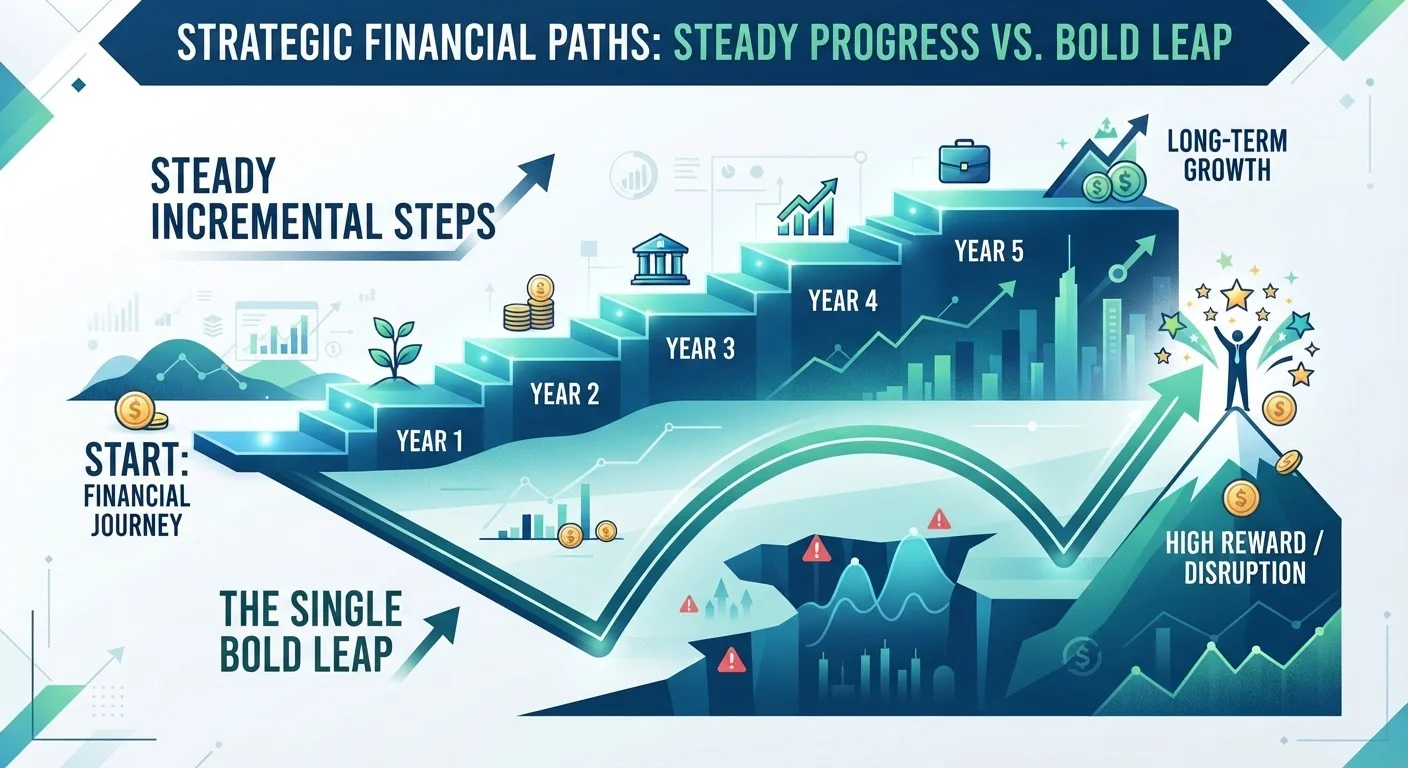
Dollar-cost averaging (DCA) means investing a fixed dollar amount at regular intervals — say, $200 every month — regardless of what the market is doing. When prices are high, your fixed amount buys fewer shares; when prices are low, it buys more. Over time, this can result in a lower average cost per share compared to making one poorly timed purchase.
Lump-sum investing means deploying all available capital into the market at once. Rather than spreading purchases over time, you invest the full amount on a single date.
Both strategies are used to build long-term wealth, typically through diversified vehicles. If you're unfamiliar with the types of accounts used for investing, our comparison of savings and investment accounts is a useful starting point. For a closer look at a popular investment vehicle, see how index funds work.
What Research Generally Shows
Multiple analyses — including widely cited research from Vanguard — have found that lump-sum investing has historically outperformed dollar-cost averaging roughly two-thirds of the time across U.S., UK, and Australian markets. The core reason is straightforward: markets tend to rise over long periods, so the sooner capital is invested, the longer it has to participate in that growth.
In a bull market (one that's trending upward), holding cash and deploying it gradually means a portion of your money sits on the sidelines, potentially missing gains. Lump-sum investors benefit from full market exposure from day one.
However, these findings come with important context. They describe historical averages across long time horizons — they do not predict what will happen in any specific future period. Markets also decline, sometimes severely, and a lump-sum investment made just before a major downturn can take years to recover. Past performance does not guarantee future results.
| Dollar-Cost Averaging | Lump-Sum Investing | |
|---|---|---|
| Historical return performance | Generally lower on average | Generally higher on average |
| Emotional difficulty | Lower — gradual commitment | Higher — full exposure at once |
| Works with regular income | Yes — fits paycheck-based investing | Requires existing large capital |
| Market timing risk | Reduced — spread over time | Concentrated at one entry point |
| Exposure to early market gains | Partial — capital staged in | Full — capital deployed immediately |
| Best environment | Declining or volatile markets | Rising (bull) markets |
The Case for Dollar-Cost Averaging
Despite the historical data favoring lump-sum investing on average, DCA offers real, practical advantages that make it the de facto strategy for most everyday investors.
- It matches how most people actually earn money. Most Americans receive income as regular paychecks, not as large windfalls. Contributing to a 401(k) with each paycheck is DCA in action.
- It reduces the risk of poor timing. No one can reliably predict market peaks and troughs. Spreading purchases over time means you're less exposed to the worst possible single entry point.
- It lowers the emotional barrier to investing. Committing a large sum to a volatile market can be psychologically daunting. Smaller, regular contributions are easier to start and maintain.
- It builds disciplined habits. Automating regular investments removes the temptation to wait for the "right moment," which often leads to prolonged inaction.
Automate to Stay Consistent
Whether you choose DCA or plan to invest lump sums over time, automation is a powerful ally. Setting up automatic transfers to an investment account removes the temptation to delay or skip contributions during periods of market uncertainty. Consistency of participation tends to matter more than precise timing for long-term outcomes.
It's also worth noting that common investing myths — like believing you need a large sum to begin — often discourage people from starting at all. DCA helps dismantle that barrier.
Key Trade-Offs to Weigh
Your individual circumstances matter more than any general finding. Consider these factors when thinking through which approach fits your situation:
- Available capital
- If you have a lump sum from a bonus, inheritance, or sale of an asset, you face a genuine choice. If you're investing from monthly income, DCA is typically your only realistic option.
- Time horizon
- The longer you plan to stay invested, the more the mathematical advantage of lump-sum investing tends to hold — because short-term volatility matters less over decades.
- Risk tolerance
- Investing a lump sum and watching it drop 20% shortly after is psychologically painful. If that reaction would cause you to sell in panic, DCA may actually produce better real-world results for you, even if theory favors lump-sum.
- Market conditions
- In extended declining markets, DCA can outperform lump-sum investing — but predicting such periods in advance is not reliably possible.
This article is for general informational and educational purposes only and does not constitute personalized financial, investment, tax, or legal advice. Please consult a qualified financial adviser before making investment decisions based on your individual circumstances.