
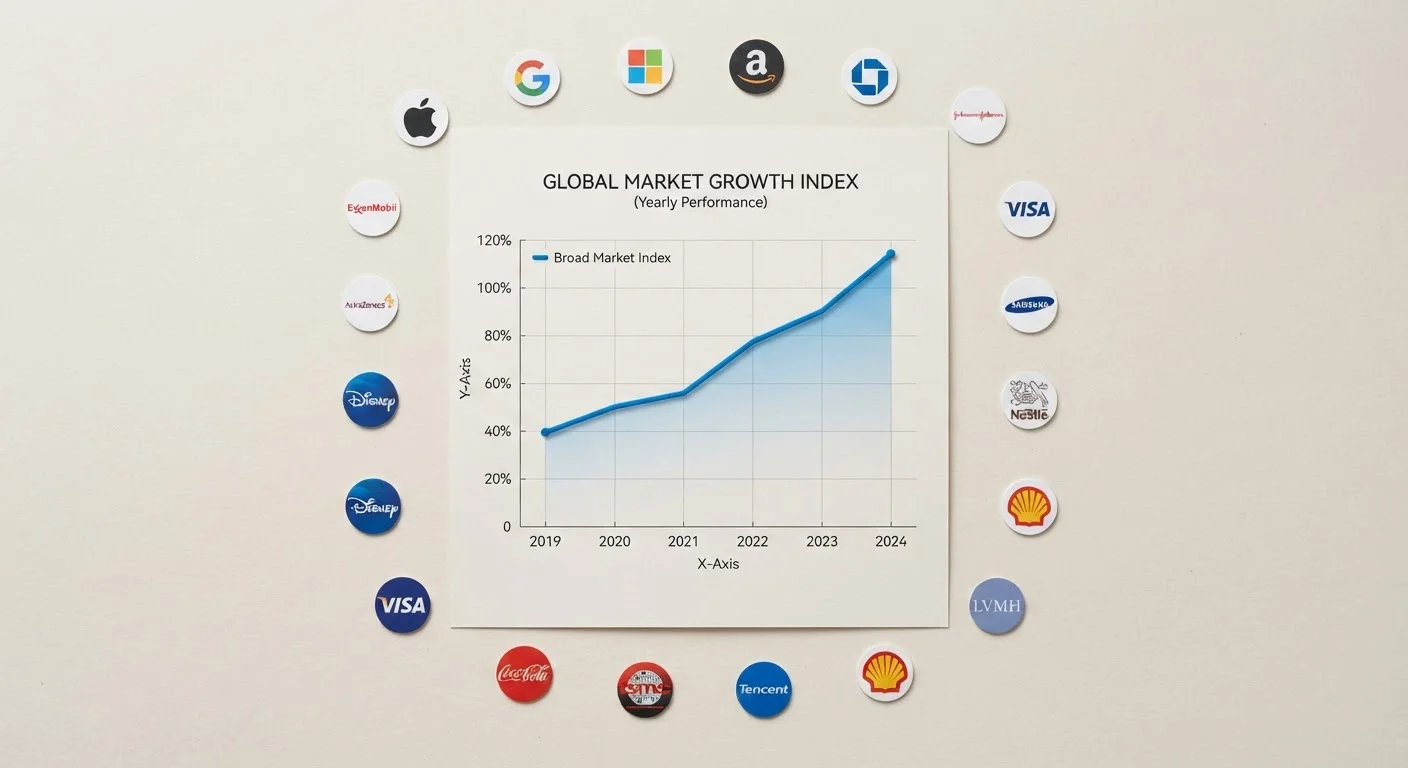
What Does an Index Fund Actually Track?
To understand an index fund, you first need to understand a market index. A market index is a list of securities — usually stocks — selected according to specific criteria, used to represent a segment of the financial market. The S&P 500, for example, tracks 500 large U.S. publicly traded companies. The Nasdaq-100 focuses on 100 major non-financial companies listed on the Nasdaq exchange. The Dow Jones Industrial Average follows 30 large U.S. corporations.
An index fund is built to replicate that list. If the S&P 500 includes a company at 2% of its total weight, an S&P 500 index fund holds roughly 2% of its assets in that same company. The fund's performance will closely mirror the index — rising when the index rises, falling when it falls. For a broader introduction to investment terminology, see our plain-language investment glossary.
Why Fees Are Central to the Index Fund Conversation
One of the most discussed characteristics of index funds is their cost structure. Because no team of analysts is actively researching and trading securities, index funds tend to have significantly lower expense ratios than actively managed funds.
~0.05%
Typical expense ratio for broad U.S. index funds
According to Morningstar's annual fee study, asset-weighted average fees for passively managed U.S. equity funds have fallen sharply over the past decade, with many broad index funds charging well below 0.10%.
~90%
Active large-cap funds underperforming their benchmark over 20 years
S&P Dow Jones Indices' SPIVA report has repeatedly found that the large majority of actively managed U.S. large-cap funds underperform the S&P 500 over long time horizons after fees.
500+
Companies held in an S&P 500 index fund
A single S&P 500 index fund gives investors proportional exposure to the 500 largest publicly traded U.S. companies across multiple industries simultaneously.
Fees matter because they compound. A fund charging 1% annually versus one charging 0.05% may seem like a minor difference, but over decades of investing, that gap can erode a meaningful portion of returns. This is why expense ratios appear prominently in nearly every conversation about index fund investing.
It's important to note that a lower expense ratio doesn't eliminate risk — it simply means less of your return is consumed by operating costs. Market risk remains fully present regardless of what a fund charges.
Diversification: What It Means in Practice
Diversification is the practice of spreading investment exposure across multiple assets so that poor performance in one area doesn't devastate the whole portfolio. Index funds provide this automatically. When you invest in a fund tracking a broad index, you're effectively holding small stakes in dozens, hundreds, or even thousands of companies simultaneously.
This doesn't eliminate risk — if the entire market segment declines, the fund declines too. But it does reduce what's called company-specific risk: the chance that a single company's failure wipes out a significant portion of your investment. Understanding how index funds fit within a broader portfolio strategy is covered in more depth in our article on asset allocation basics.
Active vs. Passive: Understanding the Trade-offs
Actively managed funds employ portfolio managers who research markets, analyze companies, and make judgment calls about which securities to buy or sell. The goal is to outperform the market. Passive index funds make no such attempt — they simply track the index.
“The stock market is a giant distraction to the business of investing. For most investors, active trading or fund-switching adds cost and rarely adds value over long holding periods.”
— John C. Bogle, Founder of Vanguard Group and pioneer of index fund investing
Research has consistently shown that, over long periods, most actively managed funds underperform their benchmark index after fees are accounted for. This finding — documented by sources including S&P Dow Jones Indices — is a primary reason index funds attract significant attention in personal finance discussions. However, this does not mean active management never delivers value, and past data does not guarantee future outcomes.
This isn't a reason to dismiss active funds entirely, but it does explain why the passive approach has become a foundational concept for many investors, particularly beginners. Those new to investing may find our guide to common investing misconceptions a useful companion read.
Index Funds Inside Retirement Accounts
Index funds can be purchased through a standard brokerage account, but they're also widely available inside tax-advantaged accounts such as 401(k)s and IRAs. Many employer-sponsored 401(k) plans offer at least one index fund option. IRAs — both traditional and Roth — typically allow investors to select index funds from a wide menu.
The combination of tax-advantaged accounts and low-cost index funds is a frequently discussed pairing in personal finance, as the tax treatment of the account and the low ongoing costs of the fund work in parallel. For more on how retirement accounts function, see our explainer on how a 401(k) works and the key differences between Roth and traditional IRAs.
How you contribute to index funds — whether all at once or over time — is also worth understanding. Our article on dollar-cost averaging vs. lump-sum investing explores both approaches and what research generally shows about each.
This article is intended for general educational purposes only and does not constitute personalised financial, investment, tax, or legal advice. Market investments involve risk, including the potential loss of principal. Consult a qualified, licensed financial adviser before making decisions about your own investments.