
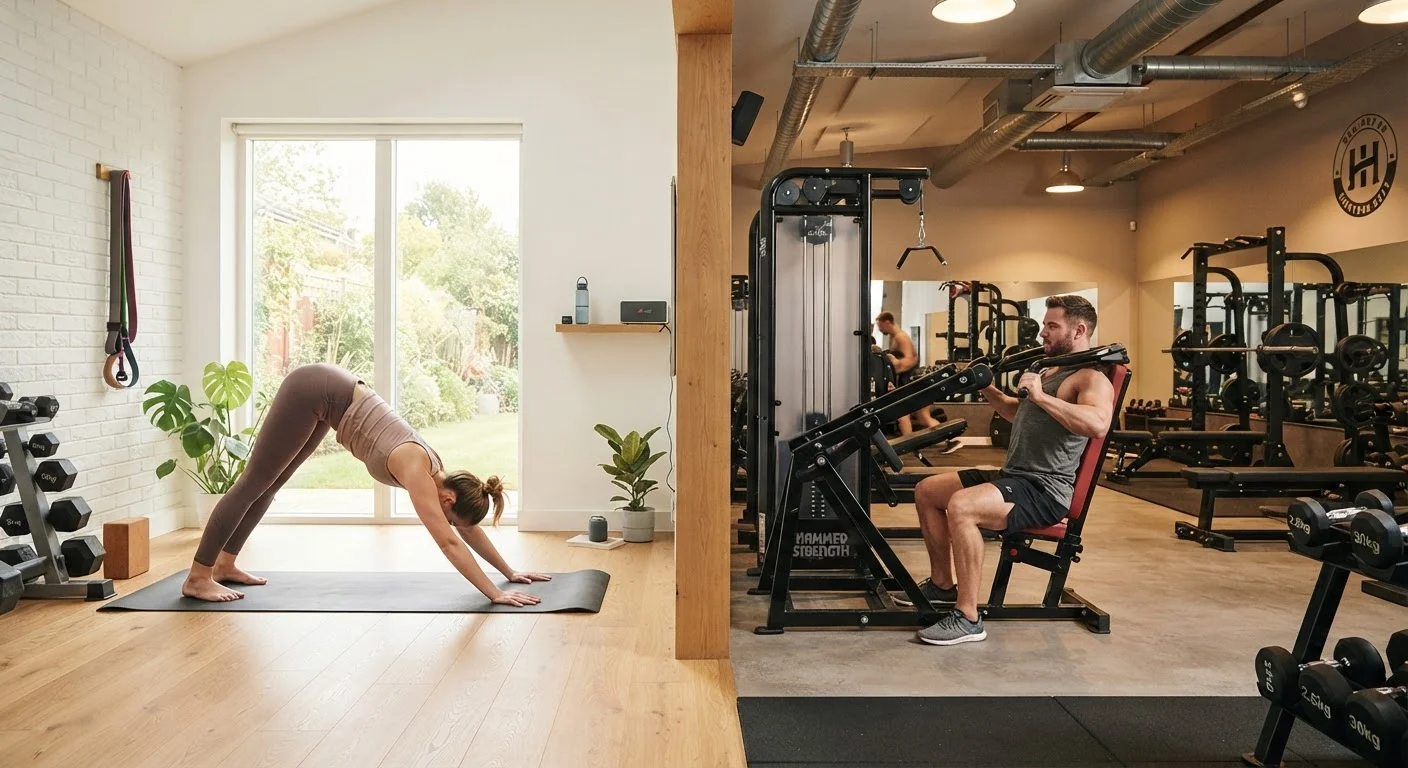
Why the Setting Matters Less Than You Think
The fitness industry has long pushed the idea that a proper workout requires a proper gym. But exercise science tells a more nuanced story. Research consistently shows that adherence — actually showing up and moving regularly — predicts outcomes far more reliably than any particular environment or equipment setup.
That means the real question isn't "which setting is better?" It's "which setting am I most likely to use consistently?" For some people that's a fully equipped gym; for others it's a cleared living room floor. Neither answer is wrong. Understanding the genuine trade-offs between the two can help you make a choice grounded in your actual life rather than fitness-culture mythology. If you're also sorting through common assumptions about exercise, our overview of fitness myths is a useful starting point.
The Real Advantages of Working Out at Home
Home workouts remove the most common barriers to exercise: commute time, membership costs, and self-consciousness. Studies on exercise behavior consistently identify time and convenience as the leading reasons people abandon fitness routines. Eliminating a 20-to-30-minute round trip to a gym can, for many people, be the difference between exercising and not exercising at all.
Cost is another meaningful factor. A basic setup — a yoga mat, a set of resistance bands, and a pair of adjustable dumbbells — can cover a wide range of training needs at a fraction of annual gym dues. And for those with variable schedules, the ability to exercise at 6 a.m. or 10 p.m. without planning around facility hours is a genuine advantage.
Home training also tends to lower the psychological friction around starting a session. There's no parking, no locker room, and no audience. For beginners especially, that reduced social pressure can make it easier to build the habit before worrying about technique refinement. Our article on short workouts explores how even brief home sessions spread across the day can produce measurable fitness benefits.
Start With What You'll Actually Use
If the idea of going to a gym creates stress or logistical hurdles, a home setup is likely to serve you better — even if it's less equipped. Research on habit formation suggests that lowering the friction of a behavior is one of the most reliable ways to make it stick. A modest home routine you perform consistently will outperform an elaborate gym plan you abandon after six weeks.
Where Gyms Have a Real Edge
Gyms offer access to equipment that is difficult or expensive to replicate at home: cable machines, barbells with full plate sets, pull-up rigs, rowing ergometers, and more. For anyone pursuing specific strength benchmarks, powerlifting, or sport conditioning, this variety matters. Matching your equipment to your goals is worth thinking through carefully before committing to either setting.
Social environment also plays a documented role in exercise behavior. Research on group exercise and social facilitation suggests that training around others — even strangers — can increase effort and duration for many people. Personal trainers and group fitness classes, typically gym-based, add structured accountability that is harder to replicate independently.
Finally, for people whose home environments are crowded, noisy, or otherwise distracting, the gym provides a dedicated physical space that signals "this time is for exercise." That psychological cue is underrated and genuinely useful for some individuals.
| Home Workouts | Gym Workouts | |
|---|---|---|
| Upfront cost | Low to moderate (basic equipment) | Low (membership only, no gear needed) |
| Ongoing cost | Minimal after setup | Monthly or annual membership fees |
| Convenience | High — no travel required | Moderate — commute adds time |
| Equipment variety | Limited by space and budget | Extensive — cables, machines, free weights |
| Social motivation | Low — typically solo | High — trainers, classes, community |
| Privacy and comfort | High — no audience | Lower — shared public space |
| Best for beginners | Yes — low friction to start | Yes — if coaching is needed |
| Scheduling flexibility | Maximum — any time | Limited by facility hours |
Matching Your Choice to Your Goals and Life
Fitness goals shape the equation significantly. General health maintenance — meeting the physical activity guidelines around moderate aerobic movement and basic muscle-strengthening — is achievable at home with minimal equipment. Building substantial muscle mass or training for competitive strength sports generally benefits from gym access, though the research on strength versus cardio shows both types of training adapt to available tools more than most people assume.
Budget, schedule density, household space, and personal temperament all factor in. A hybrid approach — primary training at home with occasional gym sessions for specific equipment or group classes — works well for many people and avoids the false binary of choosing one permanently. What matters most is building a routine you can sustain across months, not weeks.
This article is for general informational and educational purposes only and does not constitute medical or fitness advice. Consult a qualified healthcare or fitness professional before beginning a new exercise program, especially if you have any existing health conditions.