
What Each Approach Actually Involves
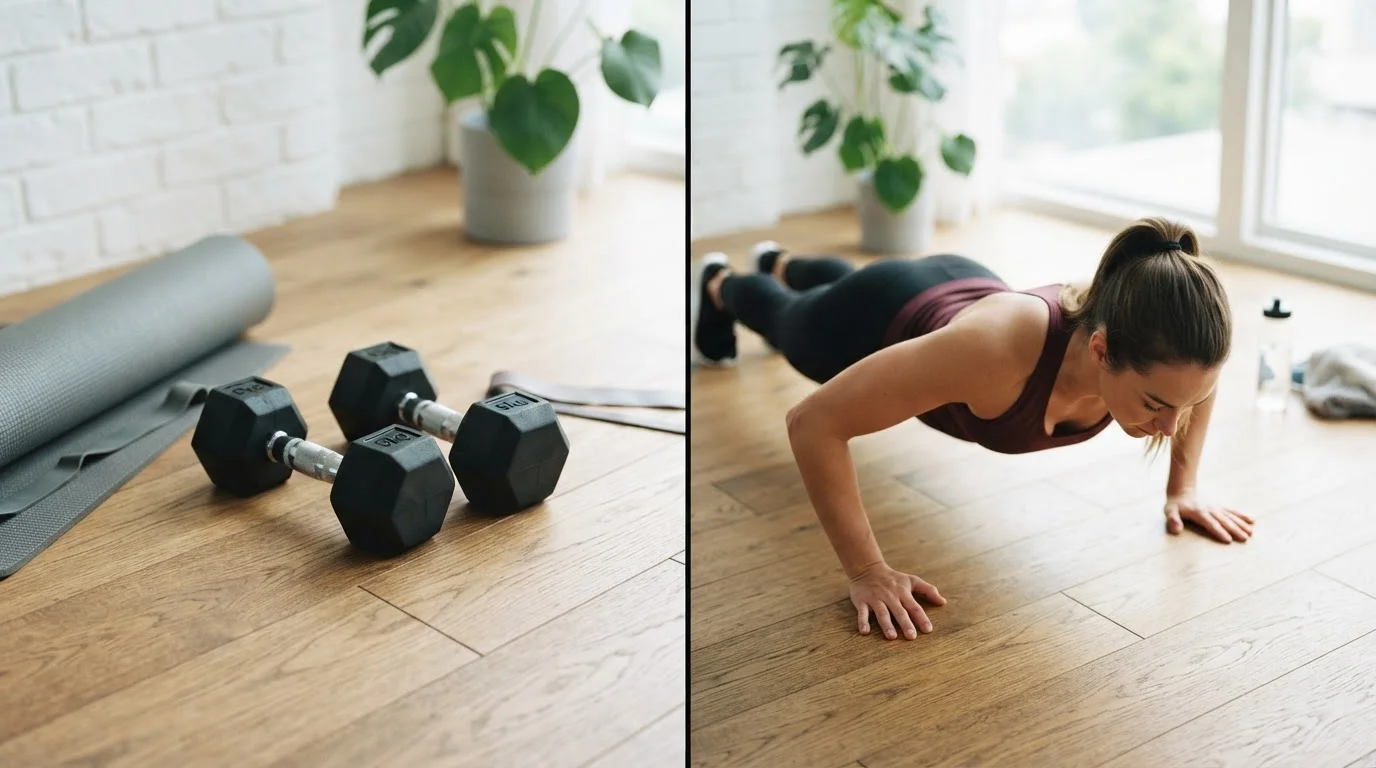
Bodyweight training uses your own body as the resistance — think push-ups, squats, lunges, planks, and pull-ups. Free weights, by contrast, refer to equipment like dumbbells, barbells, and kettlebells that you lift independently of a machine. Both are forms of resistance training, and both can improve strength, endurance, and overall fitness. The meaningful differences lie in how they deliver that resistance and what that means for your goals.
Bodyweight training is inherently relative to your size and current strength. A push-up loads your muscles based on your own body mass. Free weights let you dial in a specific, external load — say, 15 or 30 pounds — regardless of your body size. That distinction matters more than most people realize when it comes to long-term progress. For more context on how resistance training fits alongside other forms of exercise, see what the research says about strength training vs. cardio.
Side-by-Side: Key Differences at a Glance
Before going deeper, it helps to see the core distinctions laid out clearly. The comparison below covers the dimensions most readers care about — accessibility, cost, effectiveness, and flexibility.
| Criterion | Bodyweight Training | Free Weights |
|---|---|---|
| Equipment needed | None | Dumbbells, barbells, or kettlebells |
| Cost to start | Free | Low to moderate (equipment purchase) |
| Ease of progressive overload | Limited; relies on variation | High; incremental weight increases |
| Muscle isolation | Difficult for some muscles | Straightforward with right exercises |
| Location flexibility | Anywhere | Home gym or gym required |
| Learning curve | Low for most movements | Moderate; form instruction recommended |
| Functional movement training | Strong emphasis | Variable; depends on exercises chosen |
| Best for beginners | Yes | With guidance, yes |
The Case for Bodyweight Training
The most underrated strength of bodyweight training is its low barrier to entry. There's no equipment to buy, no gym membership required, and no learning curve on complex machinery. Research consistently shows that bodyweight exercises can produce meaningful improvements in muscular strength and endurance, particularly for beginners and intermediate exercisers.
Bodyweight movements also tend to train multiple joints and muscle groups simultaneously. A squat, for example, works the quads, hamstrings, glutes, and core all at once while also reinforcing movement patterns used in daily life — sitting, standing, climbing stairs. This kind of functional carryover is one reason physical therapists frequently use bodyweight exercises in rehabilitation settings.
Progression does exist within bodyweight training, though it works differently than adding weight plates. You can increase difficulty by changing leverage (elevating feet in a push-up), reducing support (single-leg variations), slowing down the movement, or reducing rest periods. That said, there are real ceiling effects — at some point, a push-up can only get so hard without adding external load. If you're wondering whether you've hit some fitness plateaus due to common misconceptions, familiar fitness myths worth revisiting may be illuminating.
The Case for Free Weights
Free weights shine when measurable, consistent progress is the goal. The ability to increase load by small, precise amounts — a concept called progressive overload — is one of the most well-established principles in exercise science for building muscle and strength. With a set of adjustable dumbbells, you can move from 10 pounds to 12.5 to 15 with deliberate control. That granularity is hard to replicate with bodyweight alone.
Free weights also allow you to isolate specific muscles more easily when needed. While compound movements like the barbell deadlift work many muscles at once, you can also use dumbbells for targeted work — a bicep curl, a lateral raise — that bodyweight doesn't replicate well. For anyone with specific aesthetic or athletic goals requiring attention to particular muscle groups, that specificity is genuinely useful.
There's a learning curve, however. Lifting with poor form under load increases injury risk. Beginners benefit from instruction — whether through a qualified trainer, guided classes, or credible video resources — before adding significant weight. The environment matters too: comparing home and gym workouts can help you think through where free weight training fits your lifestyle.
Do You Have to Choose?
In practice, many people benefit from combining both approaches rather than committing exclusively to one. A training week might include bodyweight movements for warm-ups and mobility work, free weight exercises for primary strength sets, and bodyweight finishers for muscular endurance. This kind of hybrid approach is supported by exercise science and endorsed by many fitness professionals as a practical way to build well-rounded fitness.
If you're new to structured exercise altogether, bodyweight training is a logical starting point — it teaches movement patterns safely and builds a foundation. Once those patterns are solid, introducing free weights becomes significantly safer and more productive. For readers who prefer a more social or coached environment to get started, knowing what to expect from a group fitness class may ease the transition.
This article is for general informational purposes only and does not constitute medical or fitness advice. Consult a qualified healthcare or fitness professional before beginning any new exercise program, particularly if you have existing health conditions or injuries.