Two Phases, One Election Cycle
American elections unfold in two distinct stages, yet most media coverage — and most voter attention — floods into only one of them. Understanding both is foundational to following U.S. politics with any real clarity. For a broader orientation, see our starting point for first-time followers.
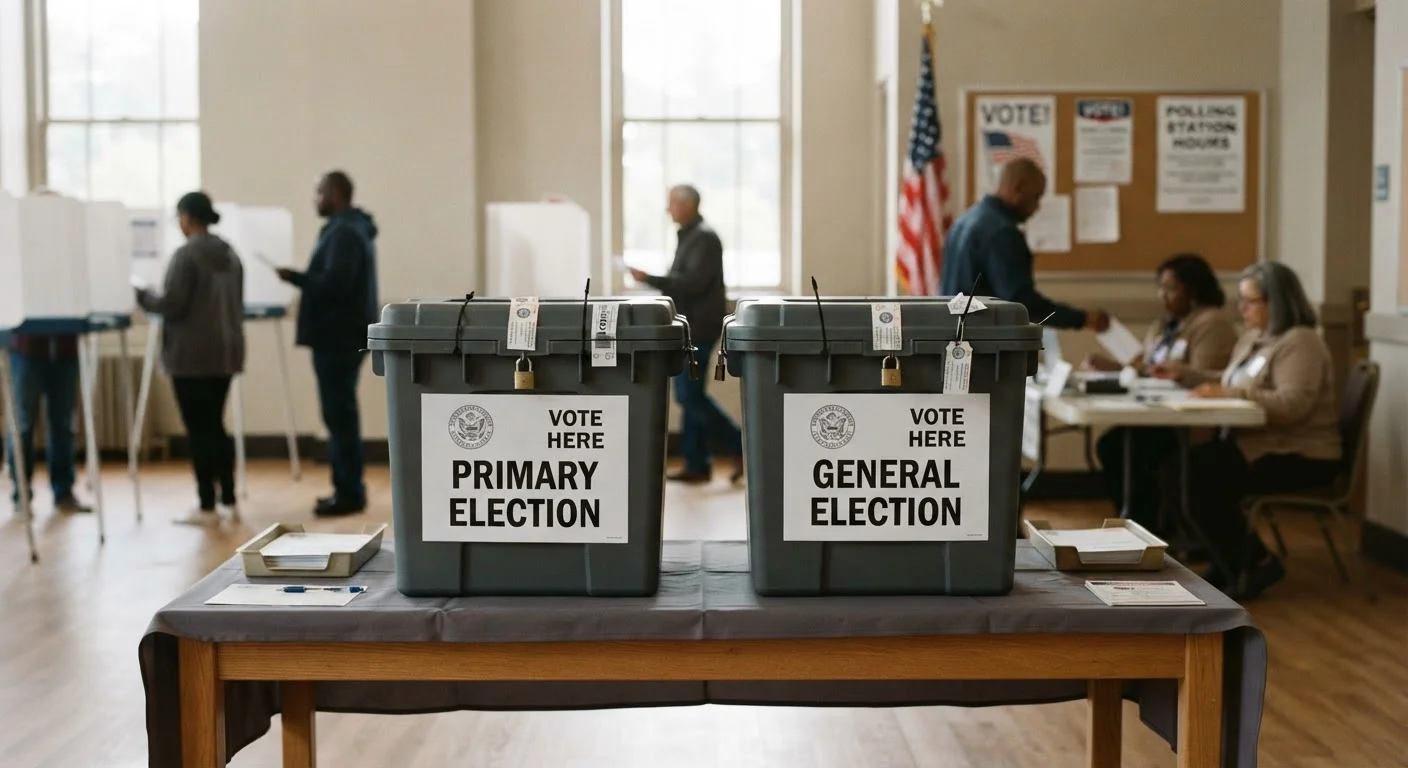
A primary election is an intraparty contest. Candidates from the same political party compete against each other for the right to be their party's official nominee. The winner advances to the general election. Depending on the state, primaries can be closed (only registered party members vote), open (any registered voter participates), or semi-closed (a hybrid). A handful of states use a top-two or jungle primary, where all candidates appear on one ballot regardless of party and the two leading vote-getters advance — sometimes producing two candidates from the same party in the general.
A general election is the final contest, typically held in November. It pits nominees from different parties — and sometimes independent or third-party candidates — against one another. The candidate who clears the required threshold (a simple majority in most races, a plurality in some) wins the office.
| Criterion | Primary Elections | General Elections |
|---|---|---|
| Purpose | Select each party's nominee | Choose the final officeholder |
| Who can vote | Varies: party members or all registered voters | All eligible registered voters |
| Typical turnout | Significantly lower | Highest of the cycle |
| Number of candidates | Multiple from same party | One per major party, plus independents |
| Timing | Months before general election | Typically November |
| Competitiveness | Often decisive in safe districts | Decisive in swing districts |
| Rules vary by state? | Yes — significantly | Yes — but more uniform |
Why Primaries Often Decide the Outcome Before November
The phrase "safe seat" describes a legislative district drawn so that one party holds a reliable, durable majority. In such districts — and there are many at both the congressional and state legislative level — the general election is rarely competitive. The party with the structural advantage almost always wins. That means the primary, where a smaller pool of voters chooses that party's nominee, is effectively the decisive election.
Political scientists and election researchers have documented this dynamic for decades. When a district leans heavily Democratic or Republican, the general election functions more like a formal confirmation of whoever survived the primary. Nominees in those races seldom lose in November.
~20%
Typical U.S. primary voter turnout
Primary turnout in most non-presidential years hovers well below general election participation, per historical data from election research organizations such as the MIT Election Data and Science Lab.
~90+
House districts rated non-competitive
Analysts at the Cook Political Report and similar nonpartisan outlets have consistently found that a large majority of U.S. House seats are considered safe for one party heading into any given election cycle.
60%+
General election turnout in presidential years
Presidential general elections regularly draw more than 60% of the voting-eligible population, compared to a fraction of that figure for most primaries, according to the United States Elections Project.
Turnout patterns reinforce this concentration of power. Primary electorates tend to skew older, more ideologically committed, and more engaged with party politics than the general electorate. That means a relatively small number of highly motivated voters can set the direction of representation for an entire district or state. For a closer look at how turnout patterns affect democratic accountability, the dynamics behind midterm turnout collapse offer a useful parallel.
Key Structural Differences Between the Two
Beyond the question of who votes and when, primaries and general elections differ in several structural ways that shape their outcomes.
Ballot access rules vary widely by state for primaries. Some states make it relatively simple for candidates to qualify; others require significant petition signatures or filing fees, which can filter out lesser-known challengers before voters ever see a ballot.
Ranked-choice voting has been adopted in a small but growing number of jurisdictions for both primary and general elections. Under this system, voters rank candidates by preference, and if no one wins a majority outright, lower-ranked candidates are eliminated and their votes redistributed. Advocates argue it reduces the spoiler effect and incentivizes broader coalition-building.
Runoffs are triggered in some states when no candidate in a primary or general election clears a required vote share. These second-round contests typically draw even lower turnout than the original primary, compressing the decisive electorate further.
Political jargon can obscure these distinctions. The plain-language guide to political terms unpacks many of the words used across both phases of the electoral process.
What This Means for Everyday Voters
The practical implication is straightforward: if you only vote in general elections, you may be arriving after many consequential decisions have already been made. In competitive swing districts, generals are genuinely decisive. But in the majority of U.S. House districts — which lean clearly toward one party — the November contest has often been effectively settled months earlier.
Participation in primaries is not always simple. Registration deadlines, closed-primary rules in many states, and lower public awareness all create friction. Voters should check their state's specific rules well in advance of primary dates, which vary by state and election cycle. Official state election authority websites are the most reliable source for this information.
It's also worth examining the assumptions we carry into election season. Several widely held beliefs about how votes are counted and how elections function don't hold up to scrutiny — something the fact-check of common election myths addresses directly. And when following campaign coverage, the framing and sourcing of political news can shape perception as much as the underlying facts — a point explored in guidance on reading political news critically.
This article is for informational and educational purposes only. Election rules, dates, and procedures vary by state and jurisdiction. Readers should verify specific voting requirements with their official state or local election authority.