How Electoral Votes Are Allocated
Every state's share of electoral votes is determined by a straightforward formula written into the Constitution: the total equals the state's number of seats in the House of Representatives plus its two Senate seats. Because every state has exactly two senators, even the smallest states are guaranteed at least 3 electoral votes.
House seats are reapportioned every ten years based on census data, so electoral vote counts shift after each census as state populations grow or shrink. Texas, for example, has grown rapidly and now holds 40 electoral votes, while states with slower population growth have seen their influence diminish over time. Redistricting, which redraws congressional district lines after each census, is closely tied to this reallocation process and shapes partisan power for the decade that follows.
The Winner-Take-All Dynamic
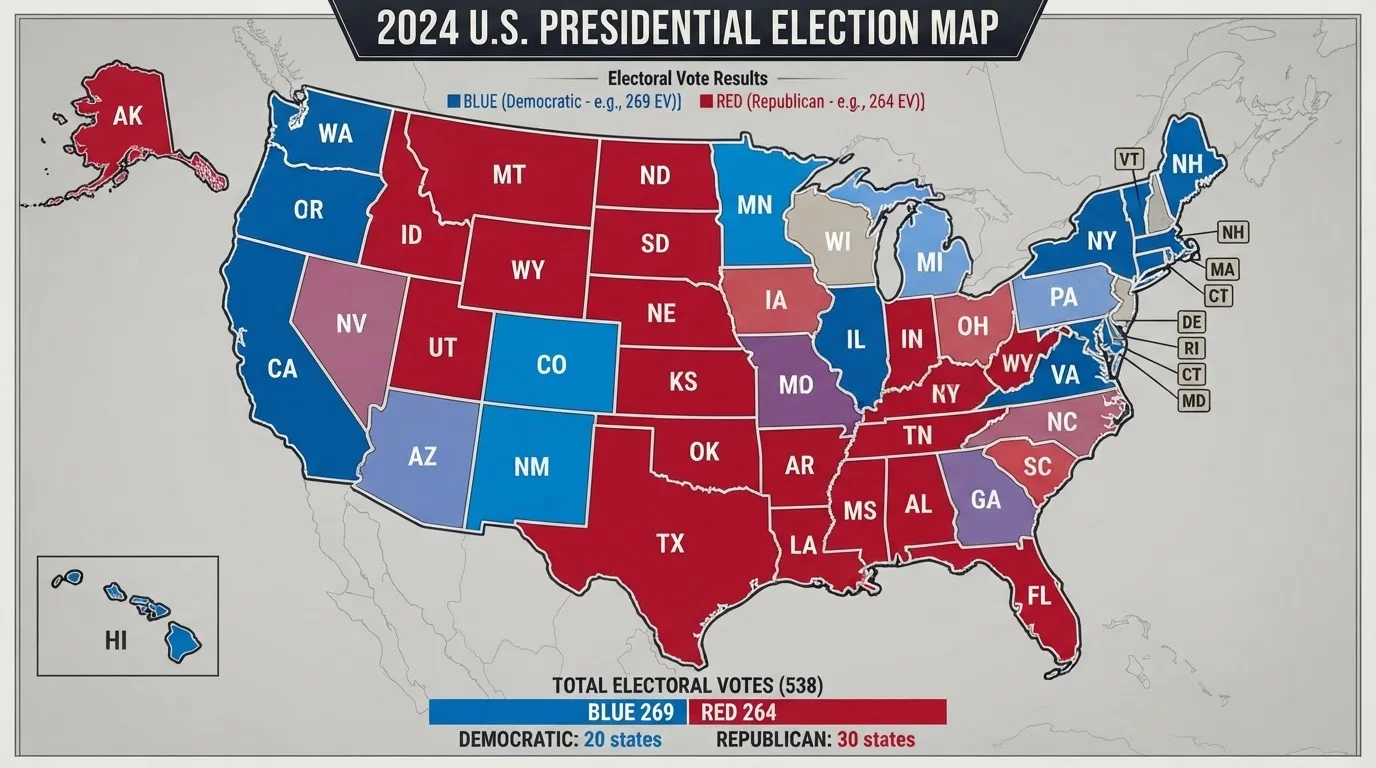
In 48 states and Washington, D.C., the presidential candidate who wins a state's popular vote — even by a single vote — receives all of that state's electoral votes. This winner-take-all structure has a major consequence: it concentrates the practical value of votes in states where the outcome is competitive.
In states where one party regularly wins by large margins, the votes of the minority party have no bearing on the Electoral College outcome. A Democrat in a heavily Republican state and a Republican in a heavily Democratic state each cast a vote that will not change how their state's electoral votes are awarded. Maine and Nebraska operate differently, awarding some electoral votes by congressional district, and have each split their votes in recent elections.
270
Electoral votes needed to win the presidency
Out of a total of 538 electoral votes, a candidate must secure a majority of 270 to be elected president of the United States.
5
Times the popular vote winner lost the presidency
Across U.S. history, the candidate who won the nationwide popular vote has lost the Electoral College — and the presidency — five times, most recently in 2000 and 2016.
3
Minimum electoral votes any state can hold
Every state is guaranteed at least 3 electoral votes due to its two Senate seats plus at least one House seat, regardless of population size.
Why Swing States Dominate Presidential Campaigns
Because electoral votes are the only currency that matters, presidential campaigns make highly strategic decisions about where to spend time and money. States where one party holds a durable advantage are largely set aside. Attention concentrates on competitive states — often called swing states or battleground states — where either candidate could plausibly win.
This dynamic means that voters in a relatively small number of states see the overwhelming majority of campaign advertising, candidate visits, and ground-level organizing. States like Pennsylvania, Michigan, Wisconsin, Arizona, Georgia, and Nevada have recurred as focal points in recent presidential cycles because their outcomes were genuinely uncertain. Voters in non-competitive states, regardless of their state's size, typically experience presidential campaigns at a distance.
How a President Is Actually Elected
On Election Day in November, Americans cast ballots for a presidential ticket. In practice, they are selecting a slate of electors pledged to that candidate. Weeks after Election Day, those electors meet in their state capitals to cast the official electoral votes — a process formalized when Congress certifies the results in early January.
A candidate who reaches 270 electoral votes wins the presidency. If no candidate achieves a majority — a scenario that could occur if a strong third-party candidate wins several states — the decision moves to the House of Representatives, with each state delegation casting one collective vote regardless of its size.
It is worth understanding how the Electoral College fits within the broader election calendar. Primary elections determine who appears on the general election ballot, often narrowing the field long before most voters are paying close attention.
There are also persistent misconceptions about how presidential elections work. Several widely believed claims about U.S. elections don't hold up to scrutiny — from how votes are counted to the role of fraud.
The Ongoing Debate Around the System
The Electoral College has been a subject of debate throughout American history, and that debate has intensified in recent decades. Critics argue that the system can produce a president who did not win the national popular vote, dilutes the influence of voters in non-competitive states, and gives disproportionate weight to smaller states through the Senate-seat component. Supporters contend that it preserves a federal structure, encourages candidates to build broad geographic coalitions, and prevents a handful of densely populated areas from dominating election outcomes.
Proposals to change or eliminate the system have circulated for generations. Some states have joined an interstate compact — the National Popular Vote Interstate Compact — under which participating states would award their electoral votes to the national popular vote winner, but only if states representing a majority of electoral votes join. That threshold has not yet been reached.
Understanding how the system works is essential for interpreting presidential election results, campaign strategy, and the ongoing political conversation about electoral reform.