
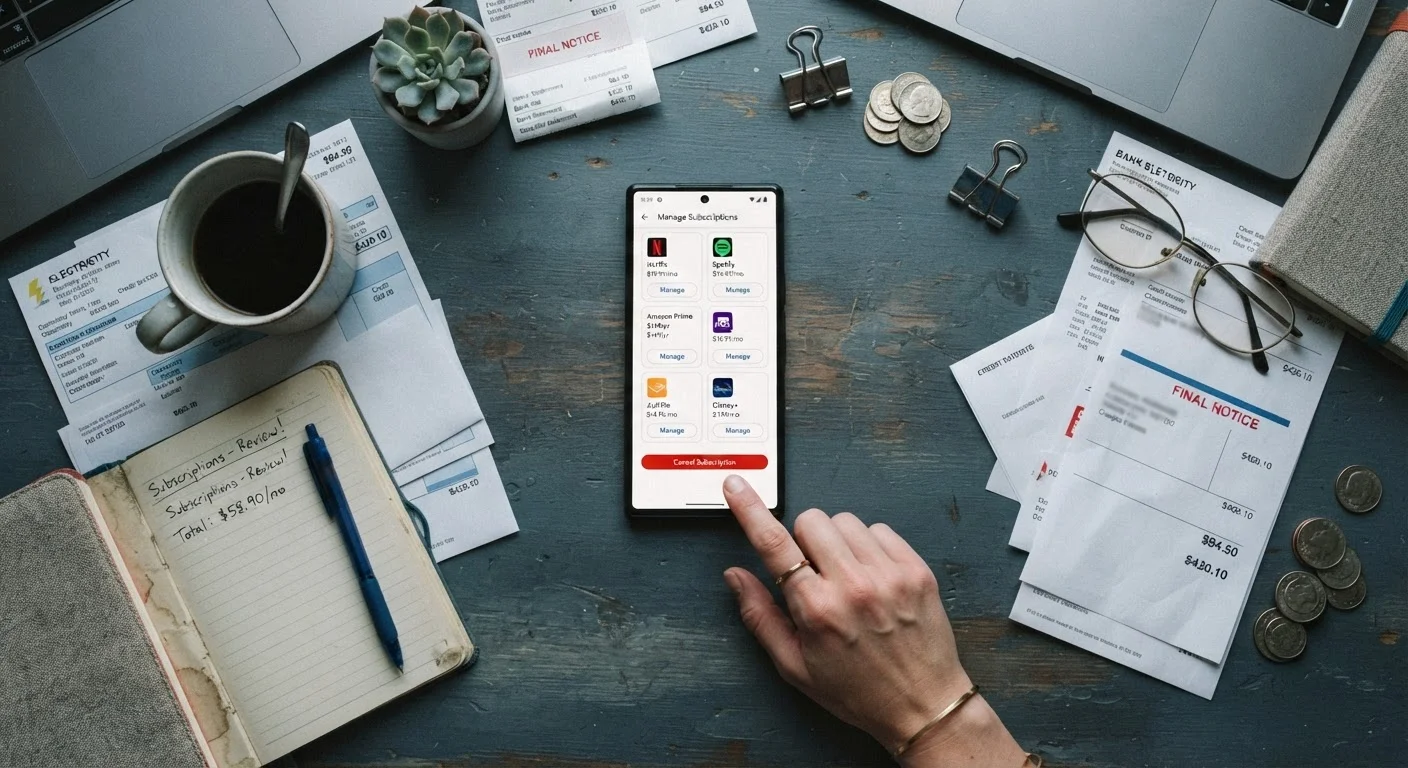
What Subscription Fatigue Actually Means
Subscription fatigue refers to the growing frustration and disengagement consumers feel when they maintain too many recurring-payment services simultaneously. It's not simply about cost — it's about the mental overhead of tracking what you're paying for, remembering to use it, and deciding whether it's still worth it month after month.
The subscription economy grew substantially through the 2010s and accelerated during the pandemic, when streaming, meal kits, fitness apps, and software tools all surged in adoption. As those services multiplied, so did the realization that convenience has a compounding price. Researchers and consumer analysts have noted a measurable uptick in cancellation activity and subscription auditing behavior as households look more critically at discretionary spending. This trend connects directly to broader patterns of cautious consumption — explored in depth in why Americans are buying less and returning more.
Understanding subscription fatigue matters because it reflects a real shift in how consumers weigh convenience against control.
The Real Advantages of Subscription Services
Before writing off the subscription model entirely, it's worth being clear-eyed about what it does well. For many services, recurring access genuinely outperforms the alternative.
Predictable cost makes budgeting straightforward
A fixed monthly charge is easier to account for than variable, per-purchase spending. This predictability appeals to budget-conscious households that want fewer financial surprises.
Access over ownership reduces upfront cost
Subscriptions let consumers use software, media, or services without a large one-time purchase. This lowers the barrier to entry, particularly for tools or content used intermittently.
Convenience eliminates repeat purchase decisions
Auto-renewal removes friction from services you genuinely rely on consistently. For staple items — like cloud storage or a news outlet you read daily — removing the decision is a real quality-of-life benefit.
Often includes updates, support, or fresh content
Unlike a one-time purchase that becomes static, many subscriptions include ongoing improvements, new content, or customer support as part of the value proposition.
The value equation holds when usage is consistent. A streaming service watched daily, a software tool used for work, or a delivery subscription that replaces frequent individual purchases can all represent sound financial decisions. The challenge is that benefits are easy to overestimate at sign-up — and easy to forget to reassess later. Building savvy buying habits means regularly questioning whether initial assumptions still hold.
Where Subscriptions Start to Work Against You
The disadvantages of subscription accumulation are real, and they tend to compound in ways that aren't obvious until you sit down and add up all the charges.
Low-use subscriptions drain budgets silently
Auto-renewal means charges continue regardless of engagement. Services signed up for during a specific season or interest often persist long after the original need has passed.
Accumulation creates unexpected total monthly spend
Individual charges appear small, but four to eight subscriptions at $10–$20 each add up to $500–$2,000 annually — a figure most households don't consciously track.
Cancellation friction is often built in deliberately
Many subscription services make cancellation deliberately difficult — burying the option in account settings or requiring a phone call. This design choice keeps subscribers who would otherwise leave.
Value perception erodes faster than habit
Consumers often continue paying for services long after they've stopped finding them valuable, simply because canceling requires active effort. Inertia is a reliable retention tool for providers.
Managing many services adds cognitive overhead
Tracking renewal dates, login credentials, and usage across multiple services takes real mental energy. This overhead is a non-financial cost that grows with each additional subscription.
One underappreciated factor is the psychological dimension: each active subscription occupies a small slice of mental bandwidth. You're not just paying money — you're also tracking due dates, managing login credentials, and occasionally feeling mild guilt about services you aren't using. This cognitive load is a documented element of subscription fatigue, and it's part of why brand loyalty is declining — consumers are more willing to walk away when the friction of staying outweighs the habit of it.
How to Think About Your Own Subscription Stack
There's no universal rule for how many subscriptions is too many — it depends on usage, budget, and what you genuinely value. But a structured approach helps cut through the inertia.
A useful starting framework: list every recurring charge, note the last time you actively used each service, and estimate what that usage cost on a per-use basis. A $15/month service used 20 times a month costs roughly $0.75 per use. The same service used once costs $15 for that single interaction — context that often changes the calculus quickly.
The Per-Use Cost Test
A straightforward way to evaluate any subscription is to divide its monthly cost by the number of times you actually used it last month. If the per-use cost exceeds what you'd comfortably pay for a single equivalent experience — a movie ticket, a gym drop-in, a one-time software license — that's a signal worth taking seriously. This test works best when applied honestly, without rationalizing future use you've been promising yourself for months.
For a more detailed framework on identifying and eliminating low-value recurring charges, see how subscription creep quietly adds up. The core principle is that small charges don't feel significant in isolation — but they aggregate into a meaningful budget line over time.
It's also worth considering whether subscription fatigue is part of a broader pattern of spending reassessment. Some consumer trends fade quickly; others mark a lasting behavioral shift. The current wave of subscription auditing looks more like the latter.