
The Gap Between the Listing and the Living Room
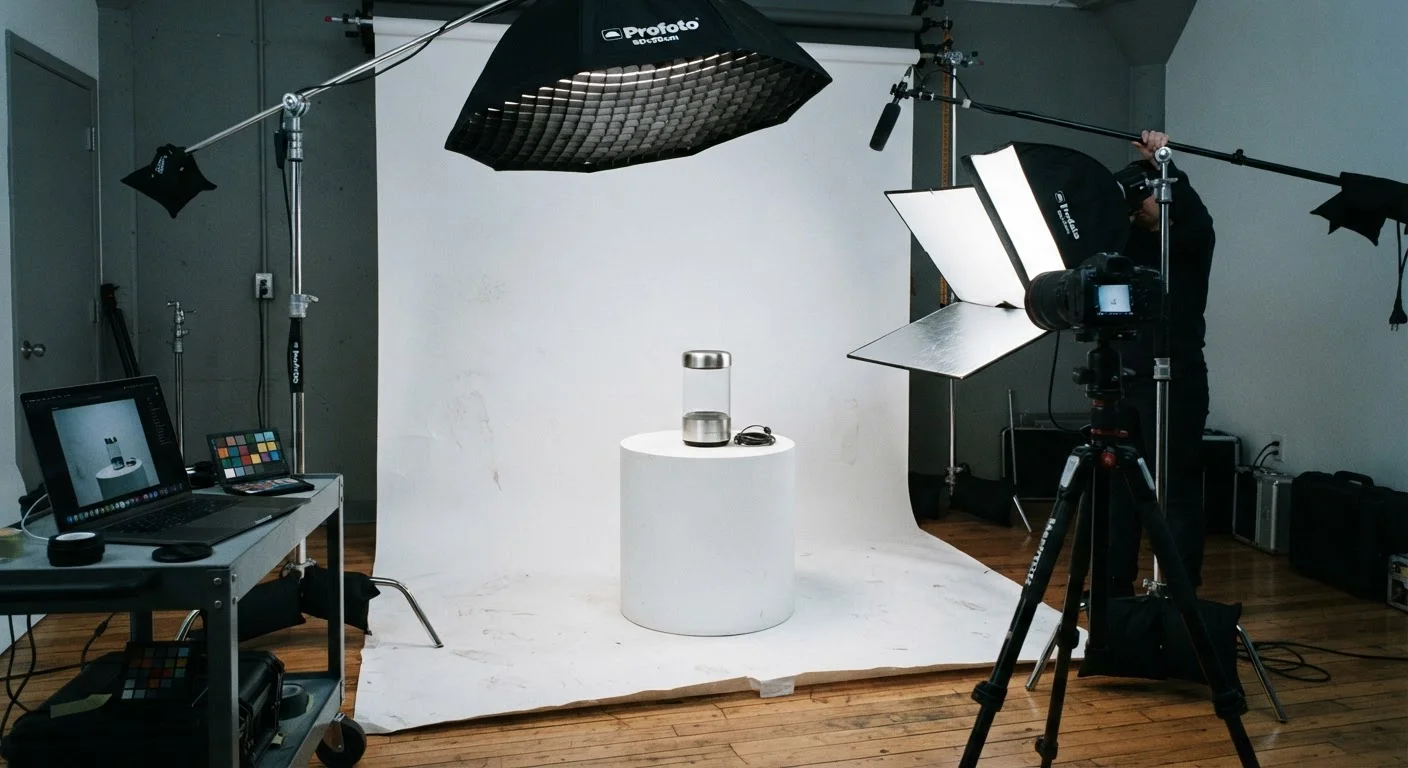
When a product photo makes a lamp look sculptural, a fabric look rich, or a piece of furniture look substantial, that's rarely an accident. Professional product photography is a discipline specifically designed to present items in their most appealing light — sometimes literally. The result is a systematic gap between what you see in a listing and what shows up at your door.
Understanding how that gap is created gives you the tools to shop past it. Photographers use wide apertures to blur distracting backgrounds, carefully calibrated color temperatures to saturate hues, and sometimes macro lenses that make small objects appear larger than they are. Post-production editing can smooth textures, remove seams, and adjust contrast in ways that alter the perceived quality of a material. None of this is necessarily deceptive in isolation — but collectively, it raises the stakes for buyers who rely on images alone.
This matters especially for categories where tactile and visual accuracy are central to the purchase: textiles, furniture, cookware, electronics, and apparel. The good news is that a few reliable strategies can help you see through the staging. For a broader look at evaluating products you can't physically handle, see our framework for online product evaluation.
Common Myths About Product Photography — Corrected
Several widely held assumptions about listing images lead shoppers to misread what they're actually buying. The myth-and-fact pairs below address the most consequential ones.
Myth
If the colors in a product photo look accurate on my calibrated monitor, the item will arrive in that exact color.
Fact
Studio lighting and post-processing routinely shift hues several shades from their true appearance, regardless of your display's accuracy.
Color accuracy in product photography is shaped by the lighting temperature used during the shoot, the camera's white balance settings, and adjustments made during editing. A fabric photographed under cool daylight-balanced LEDs will read differently than the same fabric under the warm incandescent light common in most homes. Editing software can further saturate, shift, or neutralize tones. Your monitor's calibration governs how faithfully it reproduces the image file — but if the image file itself contains an inaccurate color, perfect calibration only means you're seeing the inaccuracy clearly. For color-critical purchases, cross-reference multiple customer photos taken under varied lighting conditions.
Myth
A product that looks large and substantial in listing photos will be similarly sized in real life.
Fact
Perspective compression, close focal lengths, and isolated white-background staging routinely make products appear larger than their listed dimensions.
Without contextual reference objects in a frame — a human hand, a standard household item, a recognizable surface — the eye has no reliable anchor for scale. Photographers often shoot small products at slight low angles with a tight focal length, which exaggerates apparent volume. The fix is straightforward but requires discipline: always convert listed dimensions into physical comparisons before purchasing. Measure the actual space a product will occupy and compare it against something concrete in your environment. A 12-inch decorative object is roughly the height of a standard hardcover book — that mental image is more reliable than any studio photograph.
Myth
Multiple images in a listing give a complete and accurate picture of the product.
Fact
All official listing images typically come from a single controlled shoot designed to present the product consistently and favorably — they share the same limitations.
A gallery of eight studio photos offers more angles but not more accuracy. All shots in a product's official image set are produced under the same controlled conditions, often by the same photographer in the same session. Shadows are filled, blemishes are retouched, and the most flattering angles are selected. The appearance of variety can create a false sense of thoroughness. More genuinely diverse visual information comes from independent sources: customer photo galleries, third-party editorial reviews, and hands-on video content. These represent different environments, different lighting, and crucially, different observers with no commercial stake in the product's presentation.
Myth
Texture and material quality are reliably communicated by high-resolution product photography.
Fact
High resolution improves sharpness but cannot convey weight, flexibility, surface feel, or true material density — properties central to quality assessment.
A zoomed-in image of a fabric weave tells you about the weave's visual pattern, not its hand-feel, drape, or durability under stress. Similarly, a close-up of a metal finish can make powder-coated steel look indistinguishable from brushed aluminum. Resolution is about pixel detail, not material truth. When material quality matters to your purchase decision, look for reviewer comments that describe tactile properties — phrases like "feels plasticky," "surprisingly lightweight," or "rougher than it looks" are the signals photography cannot supply. Our foundational approach to evaluating product quality covers how to assess construction beyond the visual layer.
Myth
Customer reviews with photos are always more reliable than listing images.
Fact
Customer photos vary widely in quality and intent — some are more informative than listing images, but others can be equally staged or misleadingly filtered.
While customer-submitted images are generally more candid than professional studio shots, they are not uniformly reliable. Some platforms have documented cases of sellers incentivizing positive photo reviews. Additionally, smartphone cameras apply automatic processing — including HDR, skin-smoothing, and color boosting — that can alter how a product appears. The most useful customer photos are those accompanied by specific written observations, show the product in active use rather than posed, and come from verified purchasers who describe context ("taken in natural window light"). Cross-referencing multiple independent customer images reduces the risk of being misled by any single outlier. For a deeper look at parsing review reliability, see our guide on evaluating customer reviews without being misled.
Where to Find More Accurate Visual Information
Once you recognize the limitations of hero images, the next step is knowing where to look for more grounded visual evidence. Customer-submitted photos — available on most major retail platforms — are consistently more useful than listing images for understanding real-world color, size, and finish. These images are typically taken under mixed or natural lighting with smartphone cameras, which produces results far closer to everyday viewing conditions.
Unboxing and hands-on video reviews on platforms like YouTube offer another layer of accuracy. Reviewers routinely place products next to common reference objects — a coin, a hand, a standard shelf — that immediately calibrate scale in a way no studio shot can replicate. Look specifically for reviewers who film under natural light or in real home settings rather than staged environments.
Retailer Q&A sections are an underused resource: shoppers who have already purchased often answer dimension, color, and texture questions in plain language. These answers frequently surface discrepancies that never appear in the official listing. Pair this with a careful reading of the specification sheet — our article on what product specs actually tell you explains how to read those numbers critically rather than taking them at face value.
Finally, if physical build quality is central to your decision, understand that photography almost never conveys material weight, joint tightness, or construction integrity accurately. Our guide on build quality signals worth knowing before you buy covers the cues that photos simply can't communicate — and how to infer them through other means.