Why the 'Two-Hour Rule' Exists — and When It Falls Short
You've probably heard the standard advice: arrive two hours before a domestic flight. It's reasonable guidance — but it's also a blunt instrument that doesn't account for where you're flying from, what you're carrying, or what kind of day it is at that airport. Understanding why the rule exists helps you calibrate it to your actual situation.
That two-hour window is designed to cover check-in (if you have bags), security screening, and walking to the gate — with a modest cushion for surprises. It works well at mid-size airports on a Tuesday afternoon. It can fall apart at O'Hare on a Friday before a holiday weekend.
The core variables that should shape your buffer: airport size and layout, whether you're checking luggage, your security lane (standard vs. PreCheck), the time of day, and the season. A seasoned traveler heading to a familiar regional airport with a carry-on and PreCheck might genuinely be fine with 75 minutes. A first-time flyer at a major hub with two checked bags needs more than two hours.
Check In Online the Night Before
Most airlines open online check-in 24 hours before departure. Completing it the evening before — and downloading your boarding pass to your phone — eliminates one entire queue from your airport morning. If you have no bags to check, you can often go straight to security.
See our pre-departure checklist for everything you should handle in the days before you fly — including confirming check-in options that can save you time at the airport.
Domestic vs. International: A Different Calculation Entirely
For domestic travel, the two-hour benchmark holds for most major U.S. airports. But for international departures, three hours is the baseline — and for good reason. International check-in desks often close 60 minutes before departure (versus 30–45 for domestic). You may need to show additional documentation, complete customs forms, or navigate a separate international terminal that adds a genuine walk to your timeline.
If your international flight connects through a U.S. gateway, factor in that you'll clear U.S. Customs and Border Protection on arrival — which can take anywhere from 20 minutes to well over an hour depending on the day and the port of entry. This matters if you're building a trip itinerary that includes tight connections.
One underappreciated factor: airline-specific gate-closure policies vary. Some carriers close international gates 30 minutes before departure; others close them 45 minutes out. Check your airline's specific policy — it's usually buried in the fine print of your booking confirmation but worth finding.
~2 hrs
Recommended domestic airport arrival window
Most U.S. airlines recommend arriving at least 2 hours before domestic departures; some specify 90 minutes for smaller airports.
3 hrs
Recommended international arrival window
Major carriers and travel authorities broadly recommend 3 hours before international departures to allow for check-in, documentation, and security.
Top 10
Busiest U.S. airports by passenger volume
Airports like Atlanta Hartsfield-Jackson, LAX, O'Hare, and Dallas/Fort Worth consistently rank among the world's highest-volume hubs, where wait times are less predictable.
The Variables That Change the Equation
Beyond domestic versus international, several other factors deserve a hard look before you decide when to leave the house.
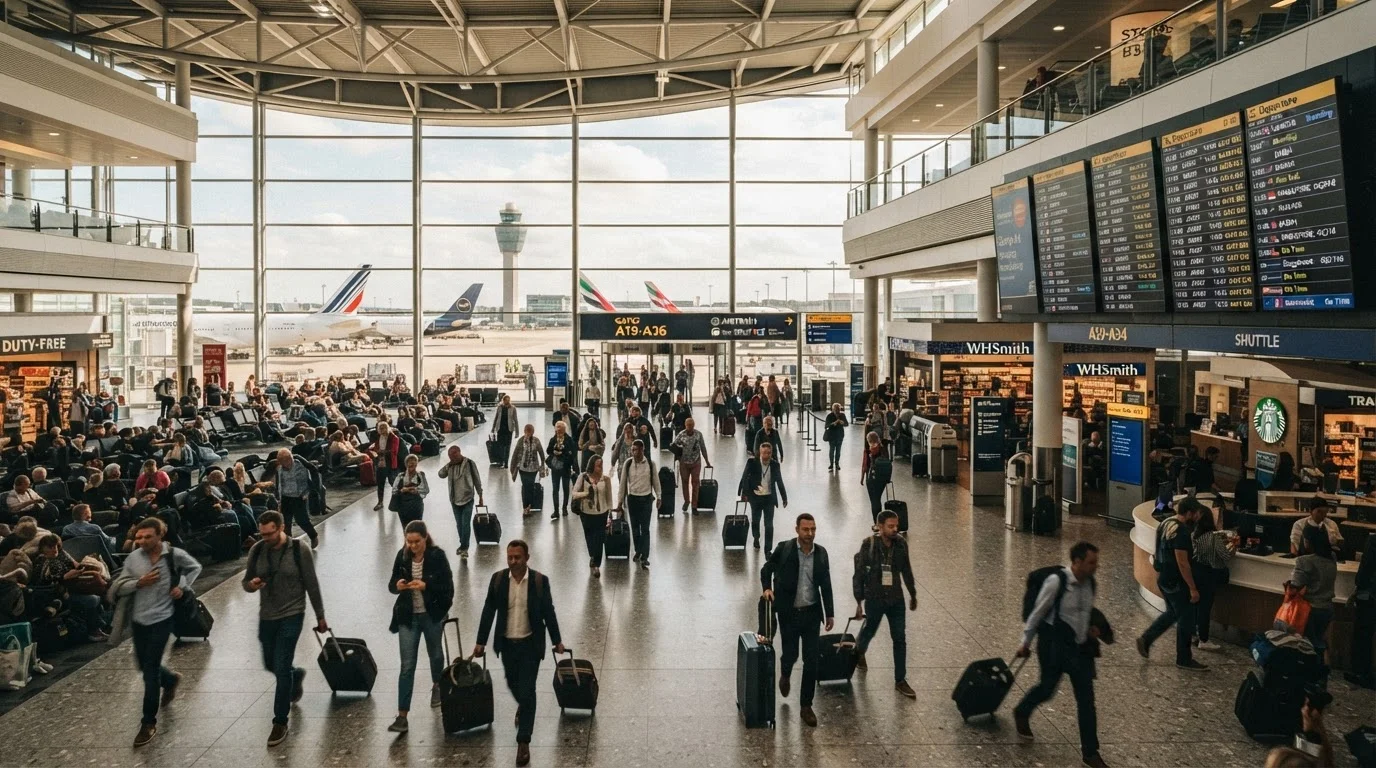
- Airport size and layout: Sprawling airports like LAX, JFK, or Dallas/Fort Worth can have terminals connected only by shuttle buses or inter-terminal trains. Adding 15–20 minutes for inter-terminal transit isn't paranoia — it's planning.
- Time of day: Early morning flights (before 8 a.m.) often have shorter security lines but can also mean drowsy driving or traffic from shift changes near major airports. Mid-day and evening departures at busy hubs can see security queues spike unpredictably.
- Checked luggage: Dropping a bag at the counter adds 10–25 minutes, depending on the line. Mobile check-in with a carry-on can cut that to nearly zero.
- Trusted Traveler Programs: TSA PreCheck and Global Entry (which includes PreCheck) can trim security time significantly, but they're not a substitute for a reasonable buffer — they're an enhancement to one.
If you're heading somewhere unfamiliar after landing, pairing your departure timing strategy with research on ground transport is smart. Our guide on airport-to-city ground transport walks through what to expect at major destinations.
What 'Plenty of Time' Actually Feels Like
Here's the honest case for generous buffer time: the airport experience genuinely improves when you're not racing. You can grab a coffee, check your gate assignment for changes, use the restroom without anxiety, and board calmly rather than being that person sprinting down the terminal with a roller bag.
“The traveler who arrives early loses a little time. The traveler who arrives late loses the flight.”
— Common travel industry adage, Widely cited among airline and airport operations professionals
Missing a flight almost always costs more — in rebooking fees, stress, and lost time at your destination — than any inconvenience from arriving a bit early. That math is rarely close.
The sweet spot for most travelers at major U.S. airports: two hours for domestic, three for international, with an extra 30 minutes layered in during holiday periods or when checking bags. That's not excessive — it's the kind of margin that lets you actually enjoy the start of your trip rather than white-knuckling it through security. And that enjoyment is, after all, the whole point.
For a fuller look at the decisions that shape a smooth departure — from long-haul comfort to smart layover planning — see our piece on overlooked long-haul flight details.