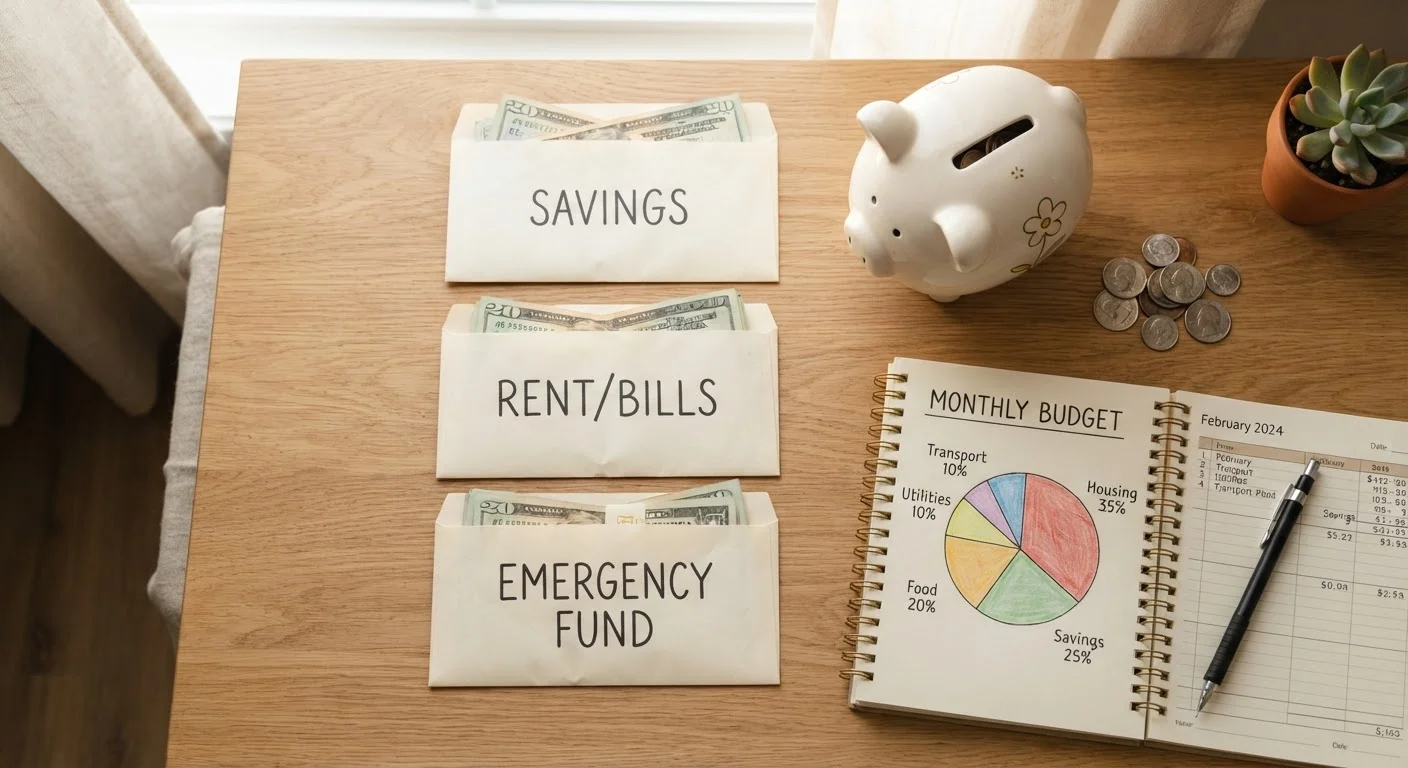

The Core Idea: A Plan, Not a Report
Many people confuse a budget with a spending summary — a look back at where the money went. That's actually a spending report. A monthly budget is the opposite: it's a forward-looking plan you make before the month begins, deciding in advance how each dollar will be used.
Think of it as a financial flight plan. A pilot doesn't take off and figure out the route mid-air. Similarly, a budget sets your direction before you start spending. This distinction matters because a plan gives you the power to make intentional trade-offs, while a report only shows you what went wrong after the fact.
At its most basic level, a monthly budget answers three questions: How much money is coming in? What are my financial obligations this month? What do I want to do with what remains? Every budgeting method — from envelope systems to spreadsheets — is just a different way of answering those same three questions. For a deeper look at the vocabulary you'll encounter, see common budgeting terms explained in plain English.
What a Budget Actually Contains
A functional monthly budget has two sides: income and expenses. Income includes every source of take-home pay after taxes — wages, freelance payments, side work, or any other regular inflow. Expenses are divided into two broad categories:
- Fixed expenses: Costs that stay the same each month, such as rent, mortgage payments, car loans, and insurance premiums.
- Variable expenses: Costs that shift month to month, such as groceries, utilities, gas, and dining out.
Understanding the difference between these two types is foundational. Fixed vs. variable expenses each require a different planning approach — fixed costs are predictable and easy to schedule, while variable costs need a spending ceiling rather than an exact figure.
A complete budget also includes a line for savings and, if relevant, debt repayment beyond the minimum. These aren't optional extras — they're expenses you pay to your future self.
~33%
Americans with a formal written budget
Surveys conducted by organizations such as Gallup and the NFCC consistently find that fewer than one in three Americans maintains a detailed monthly budget.
$6,440
Average American monthly household spending
According to the U.S. Bureau of Labor Statistics Consumer Expenditure Survey, average annual household expenditures divided monthly provide a baseline for understanding typical budget scope.
50/30/20
Most recognized personal budgeting framework
The 50/30/20 rule — allocating income to needs, wants, and savings respectively — is widely cited by financial educators as an accessible starting framework for new budgeters.
What a Budget Is Not
Clearing up misconceptions is just as important as understanding the definition. Here are the most common things a budget is not:
- Not a punishment. A budget doesn't forbid spending on things you enjoy. It simply ensures you've planned for them. If coffee is important to you, it belongs in the budget — deliberately.
- Not a one-time document. A budget isn't set and forgotten. It's a living plan that needs a monthly reset to reflect new bills, income changes, or shifting priorities. See our end-of-month review checklist for a structured way to do this.
- Not only for people who are struggling financially. High earners who don't budget often find that income growth doesn't automatically produce wealth — spending simply expands to fill available income, a pattern economists call lifestyle inflation.
- Not a rigid script. If an unexpected expense arises, you adjust the plan — you don't abandon it. Flexibility is a feature, not a flaw.
If some of these points feel surprising, you're not alone. Common budgeting myths keep many people from starting — or sticking with — a plan that could genuinely help them.
How a Monthly Budget Works in Practice
Building a budget doesn't require specialized software or financial expertise. The process follows a straightforward sequence:
- Calculate your total monthly take-home income from all sources.
- List every fixed expense and its exact monthly cost.
- Estimate your variable expenses using recent spending patterns as a guide.
- Set a savings or debt repayment target and treat it as a non-negotiable line item.
- Subtract all planned expenses and savings from income — any gap means you need to either reduce expenses or find additional income.
The math should balance: income minus all planned spending and saving equals zero, or close to it. This is the principle behind zero-based budgeting, one of several widely used frameworks. Other approaches — like the 50/30/20 rule, which allocates 50% of take-home pay to needs, 30% to wants, and 20% to savings and debt — offer different structures depending on what feels manageable.
If you've never built one before, our ground-up guide for financial beginners walks through each step in detail, with no prior financial knowledge required.
This article is for general informational and educational purposes only and does not constitute personalized financial advice. Consult a qualified financial professional for guidance specific to your situation.