Why Utilization Carries So Much Weight
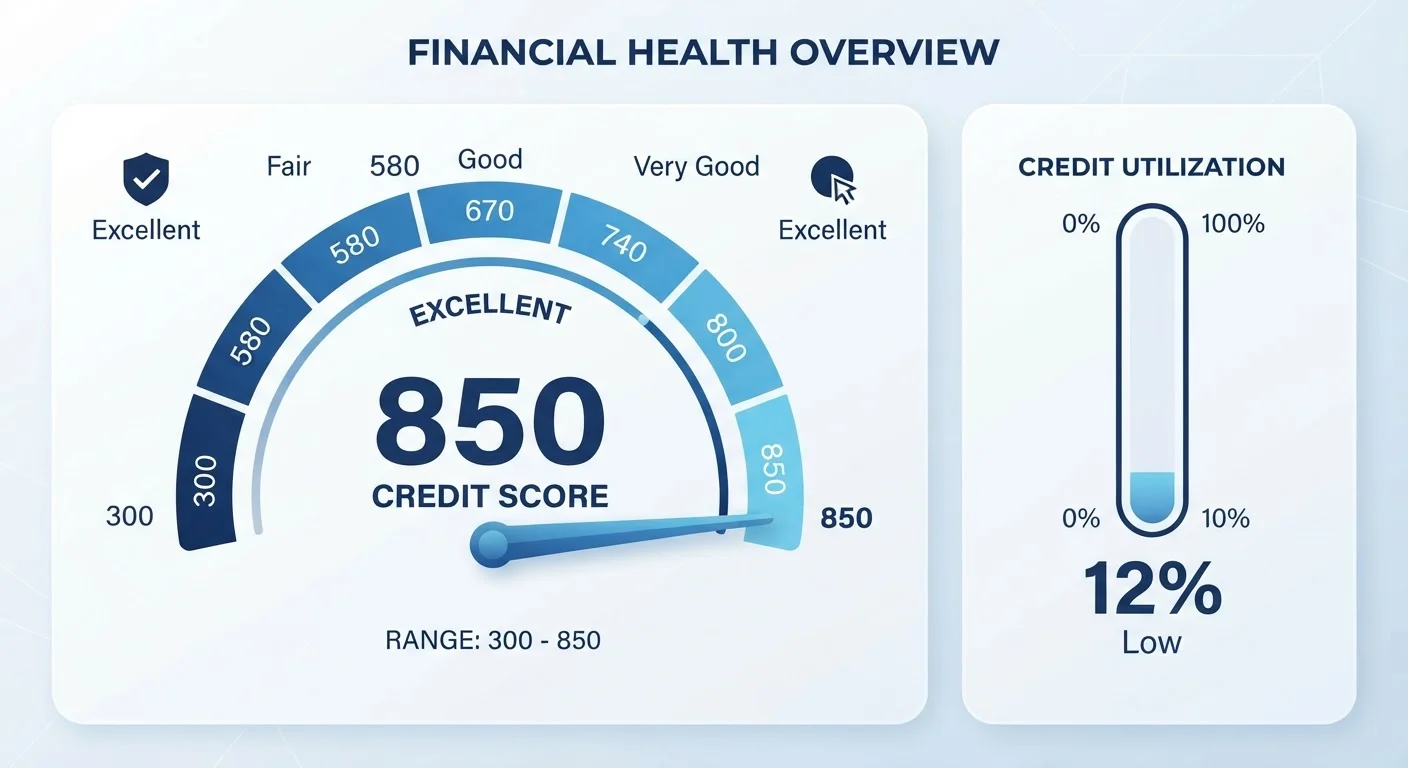
Of the five major factors that make up a FICO score, payment history is the largest — but credit utilization follows close behind. As explained in our credit scores explainer, utilization accounts for approximately 30% of your FICO score. That makes it the most immediately actionable lever most people have, because unlike payment history or credit age, it can shift meaningfully within a single billing cycle.
The core logic is straightforward: someone using 85% of their available credit looks more financially stretched — and statistically riskier — than someone using 15%. Lenders interpret high utilization as a sign that a borrower may be approaching the edge of what they can manage, regardless of whether they always pay on time.
~30%
Share of FICO score tied to credit utilization
According to FICO's published scoring factor breakdown, amounts owed — primarily utilization — is the second largest scoring category after payment history.
<10%
Utilization rate common among top scorers
FICO data consistently shows that consumers in the highest score ranges (800+) tend to maintain very low utilization ratios, often in the single digits.
30%
Widely cited utilization guideline threshold
Credit counselors and financial educators commonly recommend keeping total utilization below 30% as a practical benchmark for maintaining a healthy score.
How the Calculation Actually Works
Credit utilization is calculated at two levels simultaneously, and both influence your score:
- Aggregate utilization: Total balances across all revolving accounts divided by total credit limits.
- Per-card utilization: Each individual card's balance divided by that card's limit.
This distinction matters in practice. If you have three cards — two with low balances and one that is nearly maxed out — that single card's high individual utilization can drag your score down even if your overall ratio looks acceptable. Scoring models penalize concentration of debt on a single account.
One detail many people miss: the balance that counts is typically the balance reported on your statement closing date, not what you owe on your due date. If your statement closes with a high balance, that is what gets reported to the bureaus — even if you pay it in full before the due date. For a deeper look at how this plays out in real scenarios, see our article on common credit card balance myths.
Practical Strategies for Lowering Your Utilization
Because utilization is a current snapshot rather than a historical record, improvements can appear quickly once reported. Several practical approaches can help:
- Pay balances before the statement closing date. If you pay down your balance before the closing date, the lower balance is what gets reported — and scored.
- Make multiple payments per month. Spreading payments across the billing cycle keeps the reported balance lower without requiring you to change your overall spending habits dramatically.
- Request a credit limit increase. More available credit with the same spending means a lower ratio. Keep in mind this may involve a hard inquiry, which has a small, temporary effect on your score.
- Avoid closing old cards. Closing a card eliminates that account's available credit from your total limit calculation, which can push your utilization ratio upward — even if you carry no balance on that card.
It is worth noting that score improvements from utilization changes are not always instantaneous or dramatic. Our article on why paying off debt doesn't immediately lift your score explains the reporting timelines and realistic expectations in detail.
What High Utilization Costs You Long-Term
A depressed score from high utilization has real financial consequences beyond the number itself. Lenders use your score to set interest rates, determine credit limits, and approve or deny applications. As our companion piece on how your score affects your mortgage rate illustrates, even a modest difference in score can translate into thousands of dollars in additional interest over the life of a home loan.
The same principle applies to auto loans, personal loans, and new credit card terms. Managing utilization is not just about a number — it is about maintaining access to credit on terms that do not cost you unnecessarily. For a broader look at how credit and debt interact, the comprehensive debt and credit resource covers the complete picture in one place.
This article is for general informational and educational purposes only and does not constitute personalized financial or credit advice. Consult a qualified financial professional regarding your specific circumstances.