
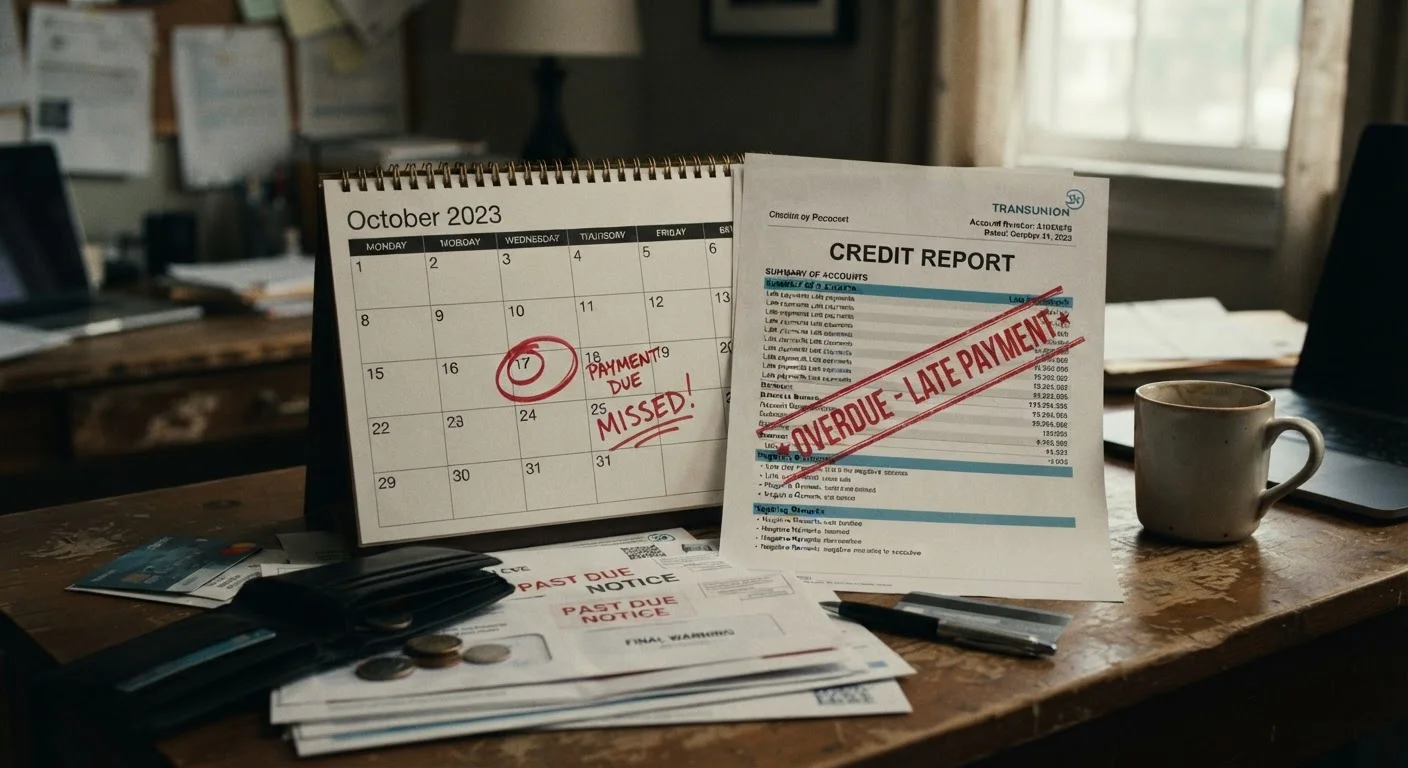
The First Few Days: Fees and Penalty Rates
Missing a payment due date does not immediately trigger a credit reporting event, but it does set off a financial clock. Most lenders apply a late fee within days of a missed due date — commonly ranging from $25 to $40 on credit cards, though the amount varies by lender and is outlined in your account agreement.
For credit cards, many issuers are also permitted to apply a penalty interest rate — sometimes referred to as a "default APR" — if a payment is late. This higher rate can apply to your existing balance and future purchases, significantly increasing what you owe over time. Reviewing your credit card agreement's terms can clarify when and how these penalties are triggered.
Act Before 30 Days Pass
If you've missed a payment but haven't yet hit the 30-day mark, you may still be able to prevent a credit bureau report. Pay at least the minimum due immediately and call your lender to explain your situation. Many creditors offer a one-time goodwill accommodation, particularly for customers with a previously clean payment history.
Even within the first 30 days, calling your lender matters. Some creditors will waive a first-time late fee or pause a penalty rate if you act quickly and have a good payment history. It's worth asking directly.
30 Days Out: Credit Bureau Reporting Begins
The most significant consequence of a missed payment — credit score damage — typically begins once an account is 30 days past due. At that point, creditors are generally permitted to report the delinquency to the three major credit bureaus: Equifax, Experian, and TransUnion.
Payment history is the single largest factor in most credit scoring models, accounting for approximately 35% of a FICO score. A single 30-day late payment can cause a meaningful score drop, with the exact impact depending on factors such as your current score, credit history length, and overall credit profile. Borrowers with stronger credit histories may see a sharper drop because they had more ground to lose. For a deeper look at how debt and scores interact, see our comprehensive credit score and debt resource.
If the account remains unpaid, creditors may report it again at 60 days and 90 days past due, with each escalation potentially causing further score deterioration.
120 to 180 Days: Charge-Offs and Collections
When an account remains unpaid for roughly 120 to 180 days, creditors often declare it a charge-off. This accounting action means the creditor has written the debt off its books as a loss — but it does not mean the debt is forgiven. You still legally owe the balance.
After a charge-off, the debt is frequently sold to or assigned to a third-party debt collection agency. The collector then has the right to pursue repayment, which may include phone calls, letters, and — in some cases — legal action. A collections account is a separate, additional negative mark on your credit report, compounding the damage of the original missed payments.
35%
Share of FICO score tied to payment history
According to FICO, payment history is the single largest factor in calculating a standard FICO credit score, making on-time payments the most impactful credit behavior.
7 years
How long a late payment stays on your credit report
Under the Fair Credit Reporting Act, most negative credit information, including missed payments and charge-offs, can remain on a consumer's credit report for up to seven years.
120–180 days
Typical window before a charge-off occurs
Most creditors write off an account as a charge-off between 120 and 180 days of nonpayment, after which the debt is often transferred to a third-party collection agency.
The nature of the debt also matters at this stage. With secured debt — such as a mortgage or auto loan — a lender may move to repossess collateral or begin foreclosure proceedings. Unsecured debts, like credit card balances, don't involve collateral but can still result in lawsuits and wage garnishment. For more on how secured and unsecured debts differ in these situations, see our explainer on secured vs. unsecured debt.
The Long-Term Credit Impact and Path Forward
Negative payment information — late marks, charge-offs, and collection accounts — can remain on your credit report for up to seven years from the original delinquency date. During this period, lenders reviewing your report will see the history, which can affect your ability to qualify for new credit, competitive interest rates, and in some cases, housing applications or employment screening.
That said, the impact of a delinquency is not static. Credit scores weigh recent behavior more heavily than older events. Consistent on-time payments after a missed one begin to rebuild your profile over time. Why score improvement takes time after paying off debt is a question many borrowers have — the answer involves how and when creditors update their reporting.
Building responsible debt management habits — such as setting up autopay, monitoring due dates, and keeping a small emergency buffer — is the most reliable protection against future missed payments.
This article is for general informational purposes only and does not constitute personalized financial, legal, or credit advice. Consult a licensed financial professional for guidance specific to your situation.