
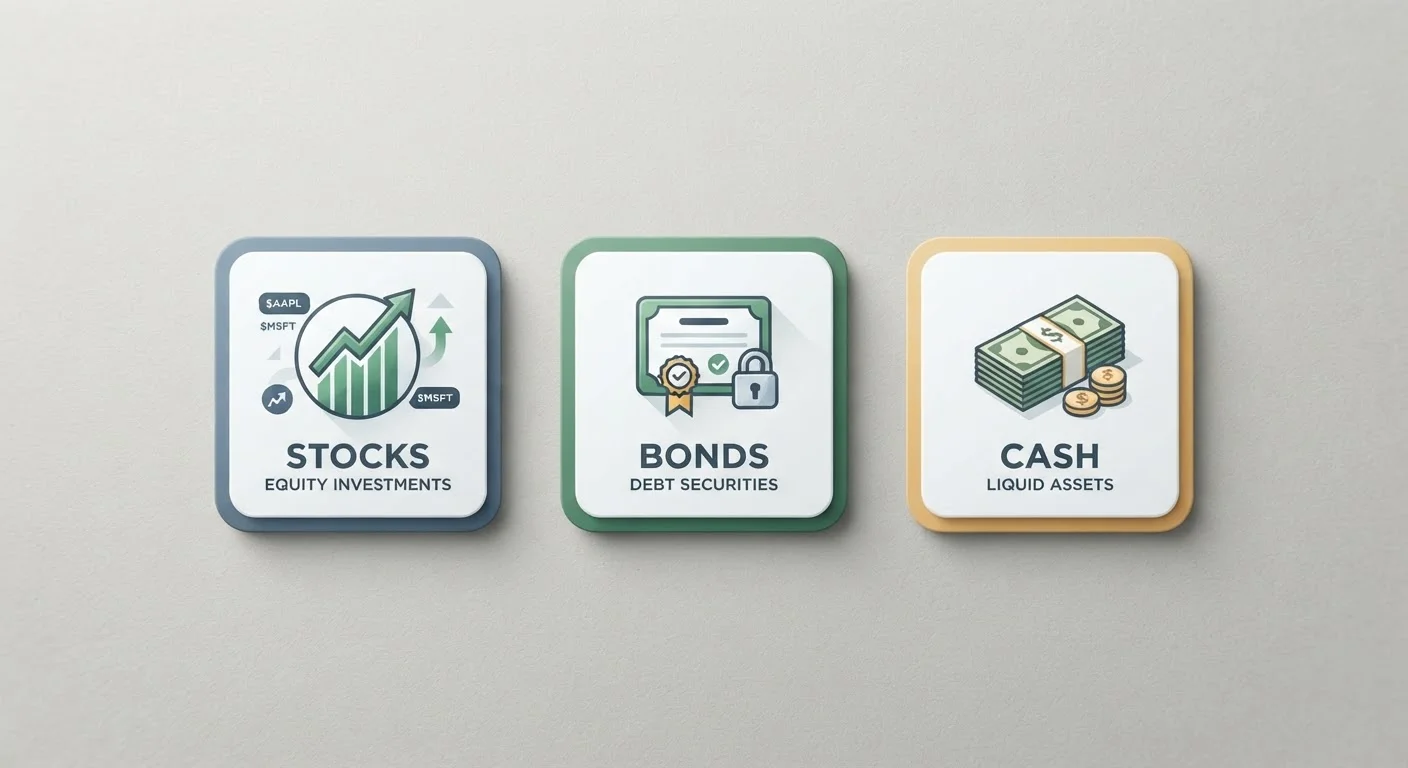
The Three Main Asset Classes
Asset allocation starts with understanding what the major asset classes actually are and how they differ in behavior.
- Stocks (equities): Buying a stock means owning a small share of a company. Stocks have historically offered higher long-term growth potential than other asset classes, but they also tend to experience larger short-term price swings. Past performance does not guarantee future results, and stock values can fall significantly.
- Bonds (fixed income): Bonds are loans made to governments or companies that pay regular interest and return the principal at maturity. They are generally considered less volatile than stocks, but they carry their own risks — including interest rate risk and credit risk.
- Cash and cash equivalents: This includes savings accounts, money market instruments, and short-term Treasury securities. Cash provides stability and easy access to funds, but typically grows the least over time.
Understanding how these classes differ is the foundation for thinking about how to divide money among them. For readers still building their financial foundation, exploring different budgeting methods is a useful complement to this topic.
Why Allocation Matters: Risk and Return
The central purpose of asset allocation is managing the relationship between risk and potential return. Holding all of your money in a single asset class concentrates your exposure — if that class performs poorly, so does your entire portfolio.
When different asset classes are combined, their varying patterns of gains and losses can partially offset each other. For example, during certain periods when stock prices fall, bonds have sometimes held their value or risen — though this relationship is not guaranteed and has varied across different market environments.
~90%
Portfolio variability explained by asset allocation policy
A widely cited 1986 study by Brinson, Hood, and Beebower found that roughly 90% of a portfolio's return variability could be attributed to its asset allocation policy, though subsequent research has produced varying estimates.
3 classes
Core asset classes in most basic portfolios
Most foundational personal finance frameworks identify stocks, bonds, and cash as the three primary asset classes used in constructing a diversified portfolio.
The appropriate mix depends on several personal factors:
- Time horizon: How long before you need this money? Longer timelines generally allow more room to ride out market downturns.
- Risk tolerance: How would a significant drop in portfolio value affect you emotionally and financially? Being honest about this is important.
- Financial goals: Saving for retirement in 30 years looks very different from saving for a home purchase in three years.
Before diving into allocation decisions, it's worth reviewing key financial moves to review before you start investing to ensure you have a stable foundation first.
How Asset Allocation Works in Practice
Suppose an investor decides on a target allocation of 70% stocks, 20% bonds, and 10% cash. After a period of strong stock market performance, stocks may now represent 80% of the portfolio. This drift means the portfolio carries more risk than originally intended. Rebalancing — selling some of the over-weighted asset and buying more of the under-weighted ones — restores the original target proportions.
Rebalancing has associated costs and tax implications that vary by account type and individual situation, so how often and how precisely to rebalance is a decision worth discussing with a qualified financial adviser.
One important point: asset allocation is not the same as picking winning investments. It is a structural decision about categories, not individual securities. Readers curious about low-cost ways to implement an allocation should understand how index funds work as a passive investing option, since they are a common vehicle used within allocation strategies.
This article is for general informational and educational purposes only and does not constitute personalized financial, investment, tax, or legal advice. All investing involves risk, including the potential loss of principal. Consult a qualified, licensed financial adviser before making decisions about your own financial situation.