
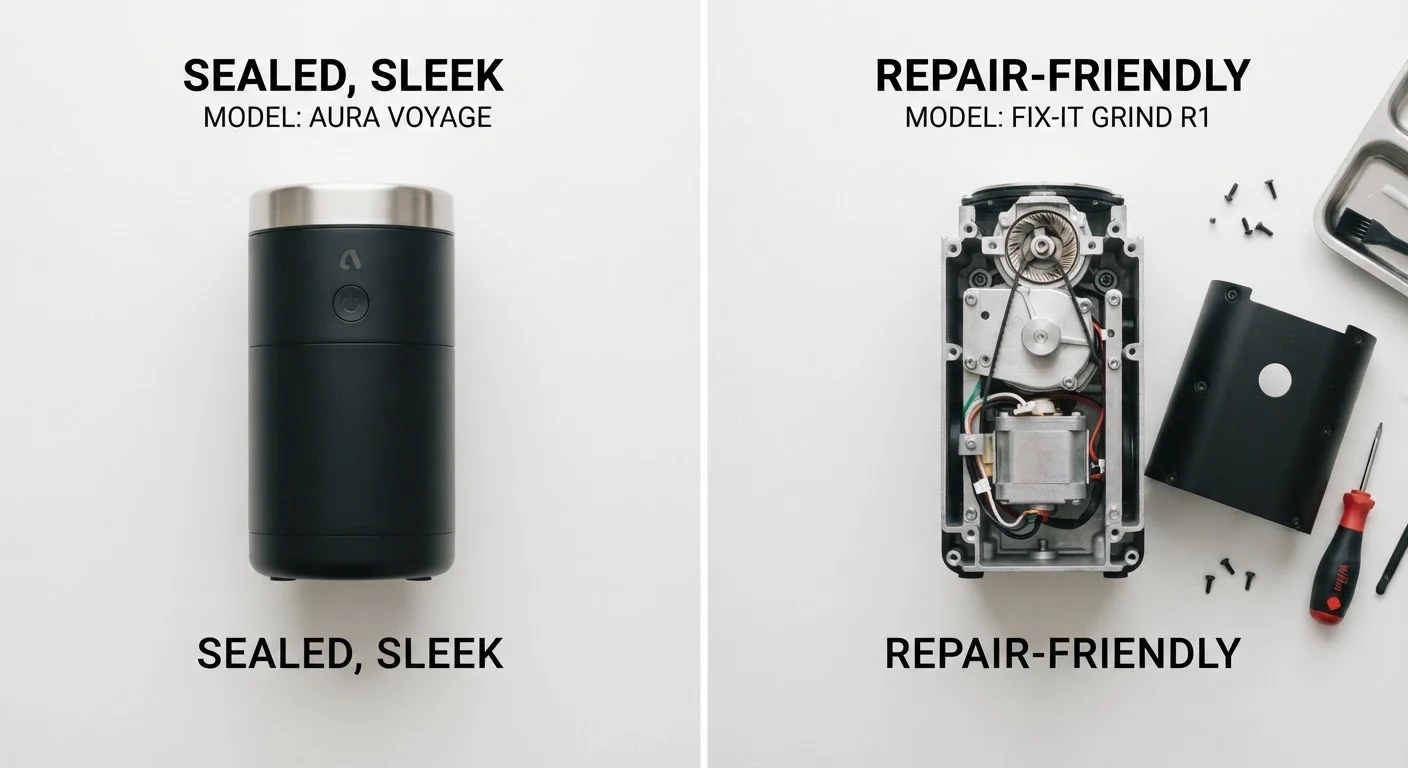
What Each Lens Actually Measures
When evaluating whether a product is worth its price, most people rely on a rough sense of quality — how solid it feels, how long similar products seem to last. Two more structured frameworks can sharpen that instinct considerably.
Lifetime value asks: how much total utility does this product deliver per dollar spent? It incorporates purchase price, expected lifespan, and the ongoing costs of ownership. A $300 appliance that reliably performs for 10 years may offer better lifetime value than a $150 model that needs replacing after four. For a deeper look at how those hidden ongoing costs stack up, see total cost of ownership.
Repairability asks a different question: when this product fails — and nearly everything eventually does — can it be fixed at a reasonable cost? Repairability covers whether components can be accessed without destroying the casing, whether replacement parts are available, and whether independent repair options exist or the manufacturer holds a monopoly on service.
The critical insight is that these two lenses can point in opposite directions. A product can be beautifully constructed yet nearly impossible to repair, meaning a single failed component ends its useful life entirely.
Where Lifetime Value Falls Short on Its Own
Lifetime value calculations typically rely on projected lifespan — a number that often comes from manufacturer claims, category averages, or consumer review patterns. The problem is that projected lifespan assumes normal use without accounting for what happens when something breaks.
Many products are engineered with planned or incidental obsolescence built into their design. Batteries are glued in. Circuit boards are proprietary. Screens require specialty adhesives to separate. In these cases, the failure of one inexpensive component can render the entire product non-functional, because the repair cost exceeds the cost of replacement. The product's theoretical lifespan never materializes.
This is why build quality signals matter so much at the point of evaluation — but build quality alone won't tell you whether the product is serviceable once it leaves the factory floor.
| Lifetime Value Lens | Repairability Lens | |
|---|---|---|
| Primary question asked | How much utility per dollar over time? | Can it be fixed when something fails? |
| Key inputs | Price, projected lifespan, ownership costs | Parts access, design openness, repair options |
| Main limitation | Assumes failure = end of life | Doesn't account for build quality or initial cost |
| Best applied to | Comparing cost efficiency across categories | Evaluating specific models before purchase |
| Risk of ignoring it | Underestimating total ownership cost | Buying unrepairable products that become disposable |
| Information sources | Manufacturer specs, consumer reviews, cost data | Repair manuals, parts catalogs, community forums |
Repairability as a Practical Evaluation Tool
Repairability isn't abstract. There are concrete, researchable factors that indicate how repairable a product actually is before you buy it:
- Parts availability: Are replacement components sold separately by the manufacturer or through third-party suppliers? Products with proprietary parts ecosystems often become unrepairable once a model is discontinued.
- Repair documentation: Does the manufacturer publish service manuals? Do independent repair communities have documented procedures? Categories like car maintenance benefit from extensive third-party repair infrastructure that doesn't exist for many consumer electronics.
- Design openness: Standard screws, modular components, and accessible internals all indicate a product designed with repair in mind. Glue, proprietary fasteners, and sealed housings suggest the opposite.
- Independent repair access: Can a local technician service the product, or is service locked to authorized centers? Authorized-only repair often means longer wait times, higher costs, and geographic limitations.
Notably, deferred or impossible maintenance carries cascading costs — a dynamic explored in detail for vehicle owners in why skipping routine maintenance costs more.
Applying Both Lenses Before You Buy
Using these frameworks together changes the questions you ask at the point of purchase. Rather than asking only "how long will this last?" you also ask "what happens when it breaks?"
For high-frequency, high-cost items — appliances, vehicles, tools, electronics — this dual evaluation is especially worth the time. A product with modest build signals but a robust repair ecosystem and widely available parts may outlast a premium alternative with a sealed design and no parts supply chain.
The savvy buying habits that separate informed consumers from reactive ones often come down to exactly this kind of pre-purchase investigation: checking iFixit scores for electronics, reading owner-community forums for appliances, or verifying parts availability before committing to a product category.
Neither framework alone tells the complete story. A product with excellent repairability but poor build quality will need constant repair. A product with excellent build quality but zero repairability becomes disposable at first failure. The most durable value lives at the intersection of both.
This article is for general informational and educational purposes only. Product lifespans, repair costs, and parts availability vary by manufacturer and market conditions. Readers should verify specifics with manufacturers, repair specialists, or independent consumer research before making purchasing decisions.