
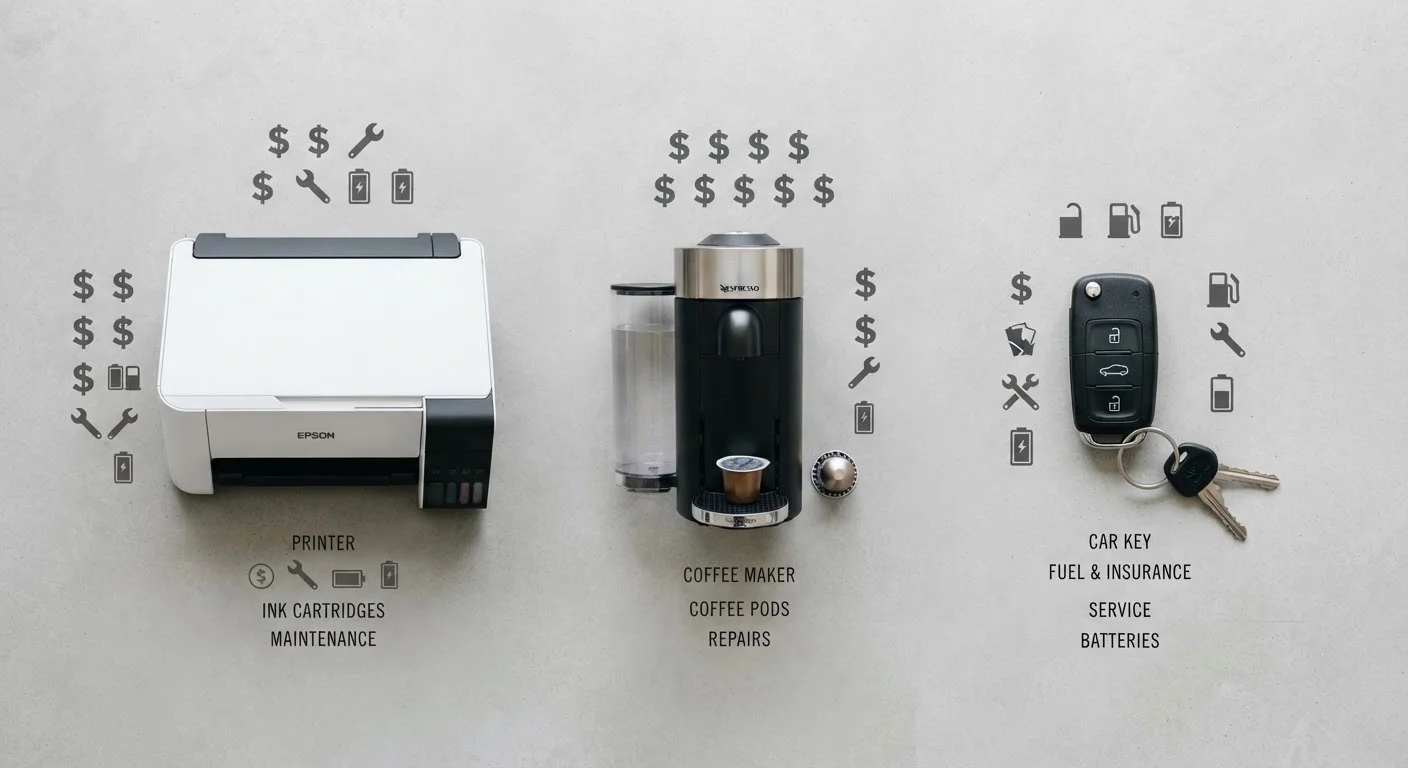
Why Purchase Price Is a Misleading Starting Point
When most people compare products, they compare price tags. That instinct is understandable — the sticker price is the most visible number in any transaction. But it's often the least representative figure for what you'll actually spend.
Consider two coffee makers: one costs $40, the other $150. At first glance, the cheaper machine seems like the obvious choice. But if the $40 model requires proprietary pods at $1 each and you brew two cups a day, you'll spend roughly $730 on pods in a year alone. The $150 machine that uses ground coffee at a fraction of the cost may pay for itself within weeks and cost far less over any 12-month period.
This is the core insight behind Total Cost of Ownership — and it applies across virtually every product category. Manufacturers frequently set low entry prices to gain market share, then recoup margin through consumables, accessories, or service contracts. Understanding this dynamic puts you in a stronger position as a buyer. For a parallel look at how this plays out in travel purchases, see how low fares can balloon with add-ons.
The Four Hidden Cost Categories That Matter Most
When evaluating any purchase through a TCO lens, four recurring expense categories deserve close attention:
- Consumables: Ink cartridges, razor blades, water filters, cleaning solutions, and replacement pods are designed to be repurchased repeatedly. These are often where manufacturers earn their highest margins.
- Energy costs: Appliances, electronics, and vehicles all consume energy at varying efficiency levels. An older or lower-quality unit running daily for years can meaningfully increase your utility or fuel bills compared to a more efficient model.
- Maintenance and repairs: Routine maintenance — oil changes, filter replacements, professional servicing — is predictable and should be budgeted. Unexpected repairs are harder to forecast but statistically more common with products that have lower build quality or poor parts availability.
- Subscriptions and connected services: A growing number of physical products now require ongoing software subscriptions, cloud storage, or extended warranty plans to function fully. These recurring charges are easy to overlook at point of purchase.
Subscription creep — the accumulation of small, recurring charges — is especially worth monitoring when buying connected devices or appliances with app-based features.
3–5x
Operating costs vs. purchase price over product lifespan
Industry analysts and consumer researchers consistently find that lifetime operating costs for major appliances and vehicles can be several multiples of the original purchase price.
$700+
Average annual U.S. household printer ink spend
Consumer Reports and independent analyses have found that ink and toner represent a disproportionately large share of printer ownership costs relative to hardware price.
~30%
Energy cost difference between efficient and standard appliances
The U.S. Department of Energy has noted that Energy Star-certified appliances can use significantly less energy than non-certified equivalents, translating to meaningful long-term savings.
TCO Across Common Product Categories
The weight of each cost category varies by product type. A few examples help illustrate how differently TCO plays out in practice:
Vehicles: The purchase price of a car can be dwarfed by insurance, fuel, registration, and routine maintenance over several years of ownership. Repairability is also a significant factor — a vehicle with expensive proprietary parts or limited independent repair options will cost more to maintain over time.
Home appliances: Energy efficiency ratings exist precisely because operating costs accumulate significantly. A washer or refrigerator running for a decade at higher wattage than a comparable efficient model can add hundreds of dollars to electricity bills. Homeowners who underestimate appliance operating costs often find their monthly budgets strained by expenses that weren't visible at purchase.
Personal electronics: Phones, laptops, and tablets often carry hidden costs in accessories, cases, chargers, and eventually battery replacements. Software ecosystems can also create lock-in that makes switching expensive — a factor that's easy to overlook when comparing upfront prices.
Printers: One of the most widely cited examples of TCO imbalance. The hardware is often sold at or near cost, with the business model built around ongoing ink or toner sales. Cost per page is a more useful metric than purchase price when evaluating printing solutions.
How to Build a Simple TCO Estimate Before You Buy
You don't need a spreadsheet to apply TCO thinking — a back-of-the-envelope estimate is enough to surface whether hidden costs change the picture significantly.
Start by identifying the product's primary consumables and their replacement frequency. If the manufacturer publishes cost-per-use data (as printer brands often do for ink yield), use it. If not, look for independent reviews or forum discussions from existing owners — they're often candid about ongoing costs.
Next, estimate annual energy costs if relevant. Energy Star ratings for appliances include estimated annual operating costs based on average usage, which gives you a usable baseline. For vehicles, published fuel economy figures combined with your typical annual mileage provide a reasonable fuel cost projection.
Finally, factor in any subscription or service plan costs that are either required or strongly recommended for the product to function well. These should be treated as part of the total price, not optional extras.
Comparing products on this combined basis — rather than sticker price alone — often changes which option looks most economical. This same framework applies well beyond physical goods: convenience-driven purchases like delivery services and pre-prepared food carry their own hidden cost structures worth evaluating. For those navigating major financial commitments, the same logic extends to real estate — renting vs. buying comparisons hinge on TCO calculations that go well beyond the mortgage payment.
This article is for general informational and educational purposes only. It does not constitute financial advice. Readers should consult a qualified financial professional for guidance specific to their circumstances.