Why These Three Checks Matter
Tires are the only part of your vehicle in direct contact with the road, which makes their condition directly relevant to braking, handling, and fuel efficiency. Yet many drivers go months without inspecting them. The good news: checking tread depth, inflation pressure, and wear patterns takes less than 20 minutes and costs nothing beyond a coin and, ideally, an inexpensive pressure gauge.
If you're new to basic vehicle upkeep, this fits neatly alongside the fundamentals covered in our plain-English introduction to car maintenance. And if you're ever evaluating a used vehicle, these same checks apply — see what else to look for in our guide on what to check before driving a used car off the lot.
What you will need
How to Check Tread, Pressure, and Wear
Work through the steps below on a flat, dry surface with the vehicle parked and the engine off. Checking all four tires individually is important — wear and pressure often differ between axles and even side to side.
Inspect each tire visually before touching it
Walk around the car and look at each tire from a few feet away. You're looking for obvious bulges, cracks along the sidewall, embedded nails or screws, or any section that appears noticeably lower than the others. Sidewall bulges indicate internal structural damage and mean the tire should not be driven on until inspected by a professional.
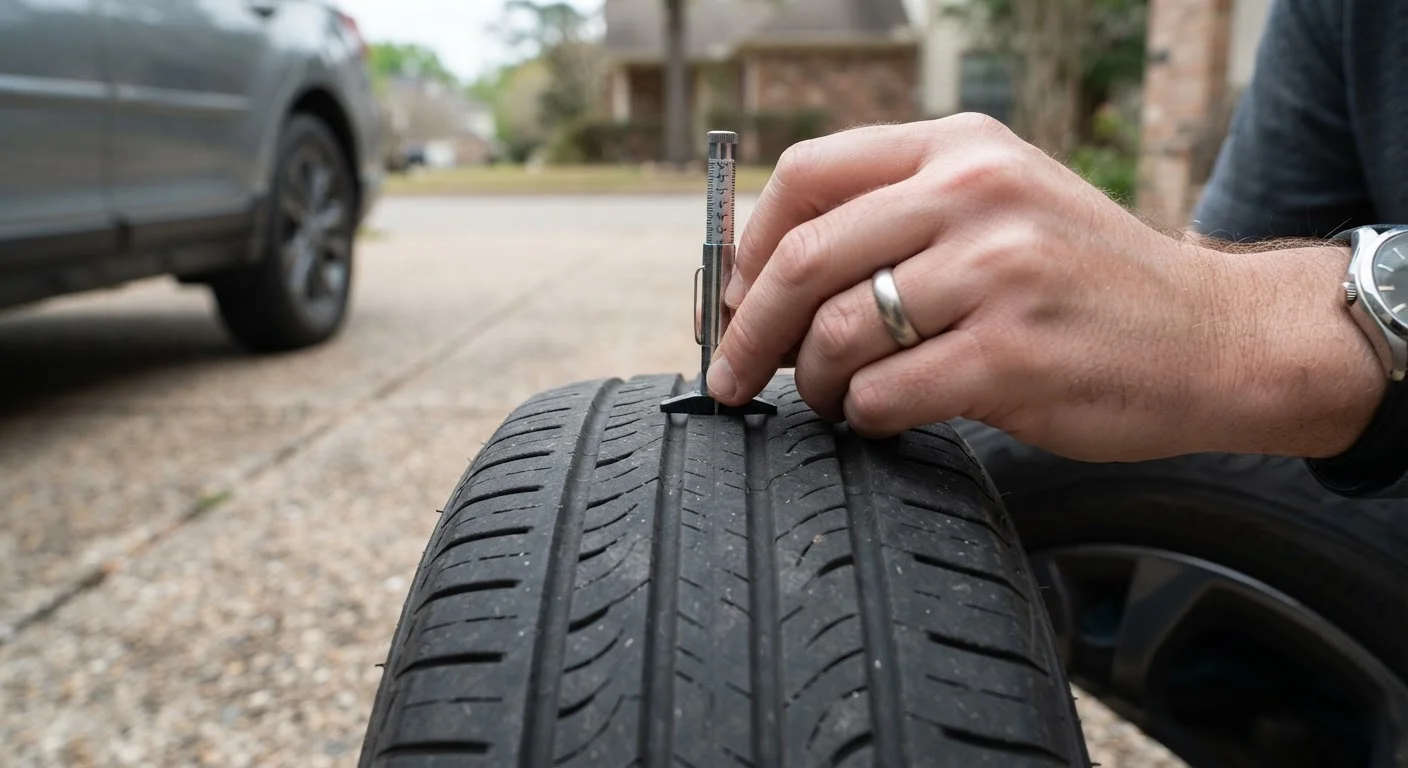
Test tread depth with the penny or quarter method
Hold a penny with Lincoln's head pointing down and insert it into a tread groove. If the top of Lincoln's head is fully visible, the tread is at or below 2/32 of an inch — the legal minimum in most U.S. states — and the tire should be replaced. For more safety margin, use a quarter: if the top of Washington's head is visible, you're at or below 4/32 of an inch, meaning replacement is advisable soon.
Test in at least three grooves across the tire's width (center and both outer edges) and repeat on all four tires. Wear that differs significantly between the center and edges points to an inflation issue; wear heavier on one edge points to alignment or suspension concerns.
Check tire pressure with a gauge
Remove the small valve cap from the tire's valve stem (the short rubber or metal nozzle on the inner rim edge). Press your pressure gauge firmly and straight onto the stem — you'll hear a brief hiss as it seats. Read the number displayed. Compare it to the recommended PSI (pounds per square inch) on the sticker inside your driver's door jamb. Note: the number molded onto the tire sidewall is the maximum pressure the tire can hold, not the recommended operating pressure — use the door jamb figure.
If pressure is low, add air at a gas station or with a portable inflator. If it's over the recommended level, press the small pin in the center of the valve stem briefly to release air, then recheck.
Read the wear pattern for alignment clues
Look closely at how each tire has worn across its width. Even wear across the full surface is normal. Wear concentrated in the center suggests the tire has been chronically over-inflated. Wear on both outer edges but not the center points to chronic under-inflation. Wear on one edge only — called camber wear — typically indicates a wheel alignment or suspension problem. Feathering or scalloping (a sawtooth or wavy surface when you run your hand across the tread) can indicate worn suspension components.
You cannot fix alignment at home, but identifying the pattern gives you clear, specific information to bring to a mechanic — which helps avoid guesswork and unnecessary service charges.
Make This a Monthly Habit
Adding a quick tire walk-around to your routine — say, on the first of each month — takes under five minutes and catches developing problems early. Pair it with a pressure check each time the seasons change, since temperature swings affect inflation noticeably. Consistent checks are far more useful than a single thorough inspection done once a year.
When to Stop DIY-ing and Call a Professional
Checking tires at home is well within reach for any driver. Correcting what you find is sometimes not. Tire rotation and replacement require proper equipment; wheel alignment requires a calibrated alignment rack that no driveway inspection can substitute for. If your checks reveal dangerously low tread, a pressure that won't hold, or a wear pattern suggesting alignment or suspension trouble, take the vehicle to a qualified shop.
Not sure which maintenance jobs make sense to tackle yourself versus hand off to a mechanic? Our article on DIY car maintenance vs. taking it to a shop breaks down where that line generally falls.
This article is for general informational purposes only. Always consult a qualified mechanic if you are uncertain about your vehicle's condition or safety.