How Ingredient Lists Are Structured
Every packaged food sold in the United States that contains more than one ingredient must carry an ingredient list, governed by regulations from the FDA. The core rule is straightforward: ingredients appear in descending order by weight as measured before the product is manufactured. Whatever is present in the greatest amount comes first.
This single rule is the most important thing to understand. A bread labeled 'whole wheat' that lists enriched white flour first contains more refined flour than whole wheat flour by weight, regardless of what the front of the package suggests. For a deeper look at how front-of-pack language can diverge from what's actually inside, see how health labels can mislead.
Composite ingredients — meaning ingredients that are themselves made from multiple components — must list their own sub-ingredients in parentheses immediately after the ingredient name. For example: chocolate chips (sugar, cocoa butter, chocolate, vanilla extract). This matters because it reveals where otherwise hidden ingredients, like sugar or sodium, are entering the product through a secondary source.
This Is General Education, Not Medical Advice
The information in this article is intended to help you understand food labels, not to guide specific dietary decisions for a health condition. If you have food allergies, intolerances, or a medical condition that requires dietary management, consult a registered dietitian or your healthcare provider before making changes to what you eat.
Decoding Hidden Names for Common Additives
Sugar, sodium, and certain fats each have a long roster of aliases that manufacturers may use on ingredient lists. This is not inherently deceptive — many names reflect chemically distinct compounds — but the practical effect is that a product can appear lower in added sugar than it is when multiple sweeteners appear separately, each in a smaller quantity.
Common names for added sugars
- High-fructose corn syrup, corn syrup solids, dextrose
- Maltose, sucrose, evaporated cane juice
- Agave nectar, honey, fruit juice concentrate
- Barley malt syrup, rice syrup, treacle
The distinction between added and natural sugars is covered in detail elsewhere, but the key point here is that the Nutrition Facts panel now has a dedicated 'Added Sugars' line — use it alongside the ingredient list, not instead of it. See what the Nutrition Facts label is telling you for a full breakdown of that panel.
Common names for sodium
- Sodium chloride, sodium nitrate, sodium benzoate
- Monosodium glutamate (MSG), disodium phosphate
- Baking soda (sodium bicarbonate), baking powder
If several of these appear in one product, their combined sodium contribution can be significant even if no single source ranks high on the list.
Use the First Five Ingredients as a Quick Guide
Because ingredients are listed in descending order by weight, the first five give you a reliable snapshot of what you're mostly eating. If refined flour, sugar, or a form of sodium leads the list, those components make up the bulk of the product. This quick scan takes seconds and is often more revealing than any front-of-pack claim.
Step-by-Step: Reading Any Ingredient List Confidently
The following steps can be applied to virtually any packaged food in a few minutes at the store or at home. Pair this habit with shopping with a structured list to make label reading a consistent part of your routine rather than an occasional effort.
Find the Ingredient List (Not the Front Label)
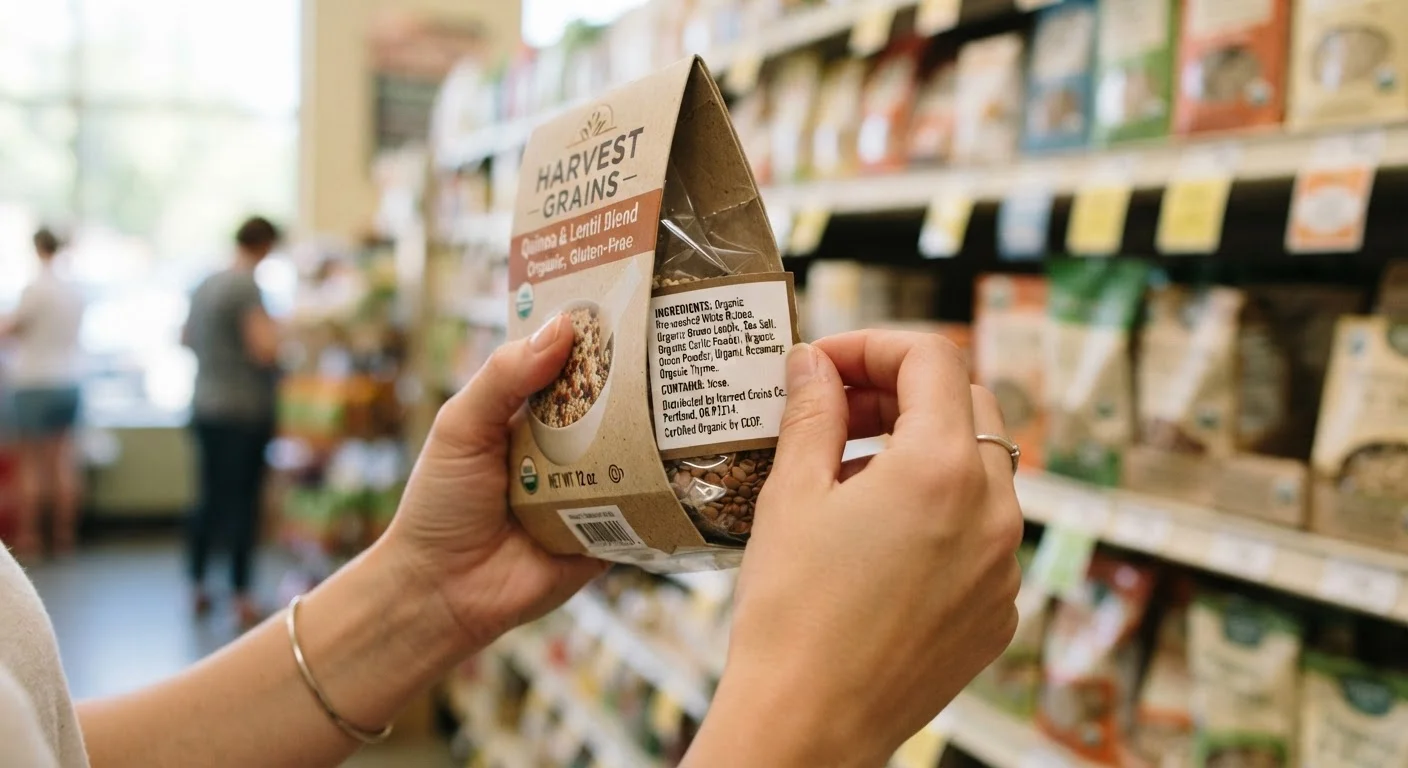
Flip the package to the back or side panel. By law, the ingredient list must appear on the same panel as, or directly adjacent to, the Nutrition Facts panel. Ignore front-of-pack claims entirely for this exercise — they are marketing language, not regulated disclosures.
Read the First Three to Five Ingredients
These ingredients make up the majority of the product by weight. Ask yourself whether they align with what the product is marketed as. If a 'vegetable soup' lists water, modified cornstarch, and sodium as its top ingredients before any vegetable, that tells you something meaningful about its composition.
Scan for Multiple Names of the Same Substance
Look specifically for sugar aliases (see the section above) and sodium compounds. Count how many appear. If three or four different sweeteners appear in the middle and lower portions of the list, their combined contribution may be higher than any single entry suggests — a practice sometimes called 'ingredient splitting.'
Open Any Parenthetical Sub-Ingredient Sections
When you see a composite ingredient followed by parentheses, read the sub-ingredients as if they were part of the main list. This is where secondary sources of sugar, sodium, or allergens often appear. A 'flavored seasoning' might contain MSG, salt, and cornstarch — all relevant if you're monitoring sodium or avoiding certain additives.
Check the Allergen Statement
U.S. regulations require that the eight major food allergens — milk, eggs, fish, shellfish, tree nuts, peanuts, wheat, and soybeans — be declared, either within the ingredient list itself or in a separate 'Contains' statement immediately after it. Sesame became the ninth major allergen under federal law effective January 2023. If you or someone in your household has a food allergy, always verify both locations.
Compare Ingredient Lists Across Similar Products
Once you understand the structure, comparing two similar products side by side becomes straightforward. Look for which product lists a whole food ingredient first, which has fewer sugar aliases, and whether the ingredient counts reflect genuine simplicity or merely clever formulation. Neither a long nor a short list is automatically better — what matters is what those ingredients are.
What Ingredient Lists Don't Tell You
An ingredient list tells you what is present and in roughly what proportion, but it does not tell you the exact amount of each ingredient, the quality of the sourcing, or how the food was processed. A product with five recognizable ingredients may still be heavily processed; one with twenty ingredients may be nutritionally reasonable depending on context.
Ingredient lists also don't reflect bioavailability — how well your body can absorb specific nutrients from a given food matrix. For a broader vocabulary around these concepts, the nutrition terms glossary is a useful reference.
Front-of-pack claims like 'natural,' 'made with whole grains,' or 'light' are far less regulated than the ingredient list itself. A product can legally claim to be 'made with whole grains' even if whole grains appear near the bottom of the list. Understanding how packaging language works helps you weigh those claims accurately alongside the ingredient list.
This article provides general nutrition education and is not intended as medical or dietary advice. Consult a qualified healthcare professional or registered dietitian for guidance tailored to your individual health needs.