Where the 3,000-Mile Rule Came From
The 3,000-mile oil change interval made practical sense for decades. Engines manufactured through much of the 20th century had looser tolerances, cruder filtration systems, and relied on conventional petroleum-based oil that degraded relatively quickly under heat and friction. Service shops and early owner's manuals reinforced that guidance, and it became deeply embedded in American car culture.
The problem is that engines and lubricants have changed dramatically since then. Tighter manufacturing tolerances, improved engine management systems, and the widespread adoption of full synthetic and synthetic-blend motor oils have pushed the realistic useful life of a single oil fill well beyond what 1970s-era guidance anticipated. The 3,000-mile rule persisted largely because quick-lube businesses found it commercially useful — and because habits, once formed, are difficult to change.
If you're just getting started with vehicle ownership, our plain-English maintenance introduction covers the fundamentals before you go any further.
Common Myths About Oil Change Frequency
Several persistent misconceptions drive unnecessary oil changes and, occasionally, dangerous neglect. The myth-and-fact pairs below address the most common ones head-on.
Myth
Every car needs an oil change every 3,000 miles, no exceptions.
Fact
Most modern vehicles are engineered for intervals of 5,000 to 10,000 miles or more, depending on oil type and driving conditions.
The 3,000-mile standard was appropriate for older engines running conventional oil. Today's vehicles — particularly those built after the mid-2000s — operate with far tighter engineering tolerances and are typically factory-filled with synthetic or synthetic-blend oil designed to last considerably longer. Following an unnecessarily short interval doesn't improve engine protection; it simply increases your maintenance spending.
Myth
Dark-colored oil means it needs to be changed immediately.
Fact
Oil darkens naturally as it does its job, and color alone is not a reliable indicator of remaining oil life.
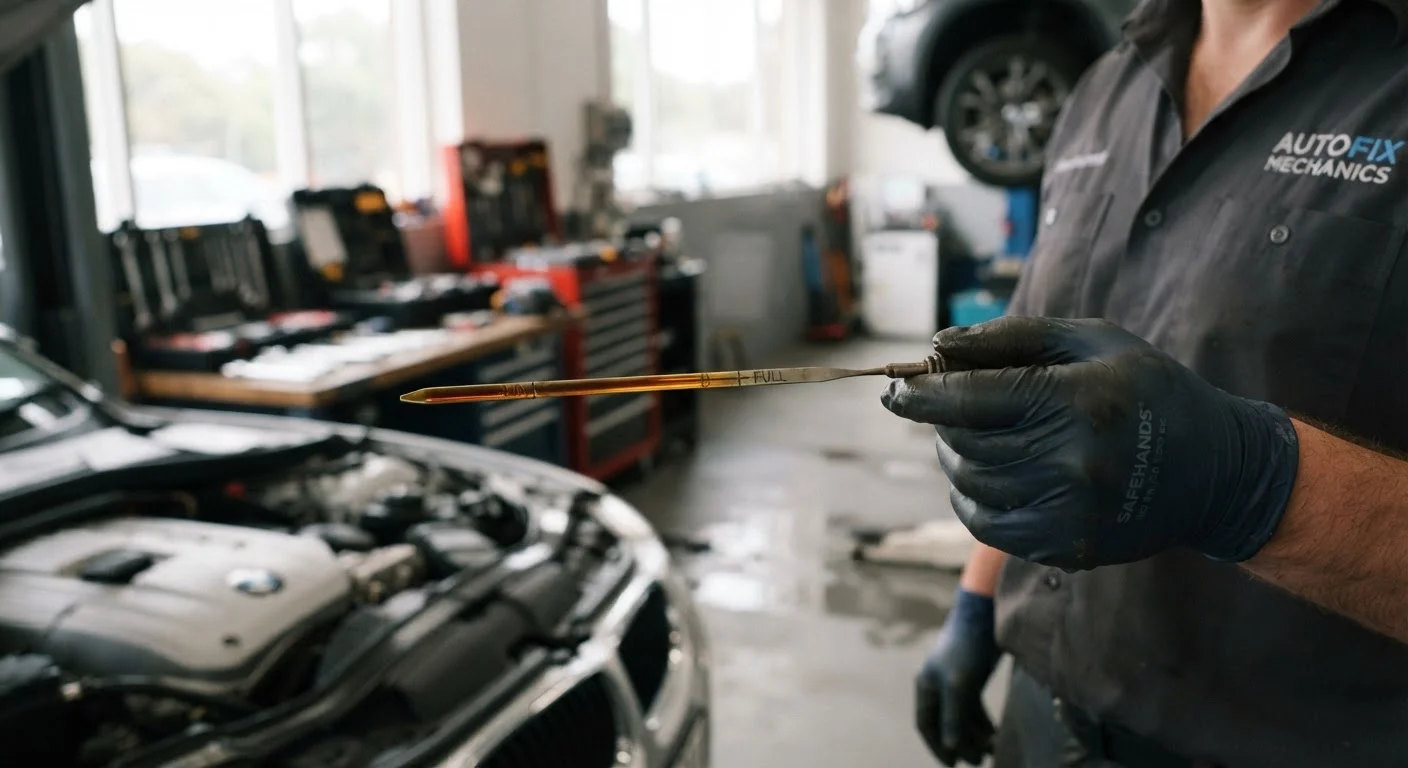
Motor oil turns dark because it suspends combustion byproducts and fine particles, keeping them away from engine surfaces — which is exactly what it's designed to do. Fresh oil that has done a single hard drive may look dark on the dipstick. Clarity or color tells you very little about whether the oil has lost its protective properties. Use your vehicle's oil life monitor or your owner's manual interval as the actual guide.
Myth
Synthetic oil causes engine leaks in older vehicles.
Fact
Modern full synthetic oil does not cause leaks, though it may reveal pre-existing seal deterioration that conventional oil temporarily masked.
An older formulation concern that has lingered in popular belief: early synthetic oils in the 1970s and 1980s used chemical compounds that could swell or degrade certain rubber seals. Modern synthetic oils are formulated to be compatible with contemporary seal materials. If switching to synthetic reveals a weeping seal in a high-mileage engine, the seal was already compromised — the synthetic oil made the problem visible rather than creating it.
Myth
If you switch to synthetic oil, you can never go back to conventional.
Fact
Synthetic and conventional motor oils are generally compatible and can be mixed or switched without damaging an engine.
There is no chemical reaction that damages an engine when synthetic and conventional oils are mixed or alternated, provided the oil meets the viscosity grade and specification called for by the manufacturer. Mixing different types may dilute the performance advantages of a full synthetic, but it will not harm an engine. The key requirement is always matching the viscosity and certification standard listed in the owner's manual.
Myth
The sticker on your windshield from a quick-lube shop sets your official oil change schedule.
Fact
Those stickers reflect the shop's recommended service interval — often set conservatively — not your vehicle manufacturer's actual specification.
Quick-lube service reminders are a courtesy, and they are frequently set at 3,000 miles regardless of what your owner's manual specifies. Your manufacturer's guidance — informed by the actual design of your engine and the oil it requires — is the authoritative source. Many vehicles also display an oil life percentage through the dashboard instrument cluster, which updates based on real driving data and is a more accurate prompt than any paper sticker.
What Actually Determines Your Real Interval
The single most reliable guide to your oil change interval is your vehicle's owner's manual. Manufacturers engineer their recommendations based on actual engine design, oil capacity, and the type of oil specified — not general industry convention. Many late-model vehicles also include an oil life monitoring system (OLMS), a software-based tool that tracks engine load, temperature cycles, and operating conditions to estimate remaining oil effectiveness. When the system alerts you, that's the cue to schedule a change.
Driving conditions matter significantly. The "severe service" category — which includes frequent short trips under five miles, stop-and-go urban traffic, extreme temperature climates, trailer towing, or extended idling — can legitimately cut the recommended interval in half. If your daily drive fits that pattern, a shorter interval may be warranted even with synthetic oil.
Understanding the role oil plays alongside other fluids under the hood is also worthwhile. Our guide to the fluids under your hood explains what each one does and how to check them.
For older, high-mileage vehicles, the calculus can shift. Worn seals, accumulated contaminants, and slightly increased oil consumption may make more frequent monitoring appropriate. High-mileage vehicle care requires a different approach — one that accounts for an engine's age and condition.
The Real Cost of Getting the Interval Wrong
Changing oil too often is primarily a financial inconvenience — the engine won't suffer for fresh oil. The math adds up quietly, though: a driver changing oil every 3,000 miles on a vehicle that legitimately needs it every 7,500 miles is paying for roughly two and a half unnecessary services per year.
Going too long in the other direction carries genuine risk. Oil that has exceeded its effective life begins to break down into sludge, loses viscosity (its ability to maintain a protective film between moving metal parts), and can no longer neutralize combustion byproducts efficiently. Extended neglect can cause accelerated wear on bearings, camshafts, and cylinder walls — damage that is expensive to repair and sometimes irreversible. Deferred maintenance almost always costs more in the long run.
The takeaway is balance: follow the manufacturer's guidance, adjust for your actual driving conditions, and choose the right oil type for your engine. Understanding the differences between synthetic and conventional motor oil is a practical next step before your next service visit.